The question that started this guide
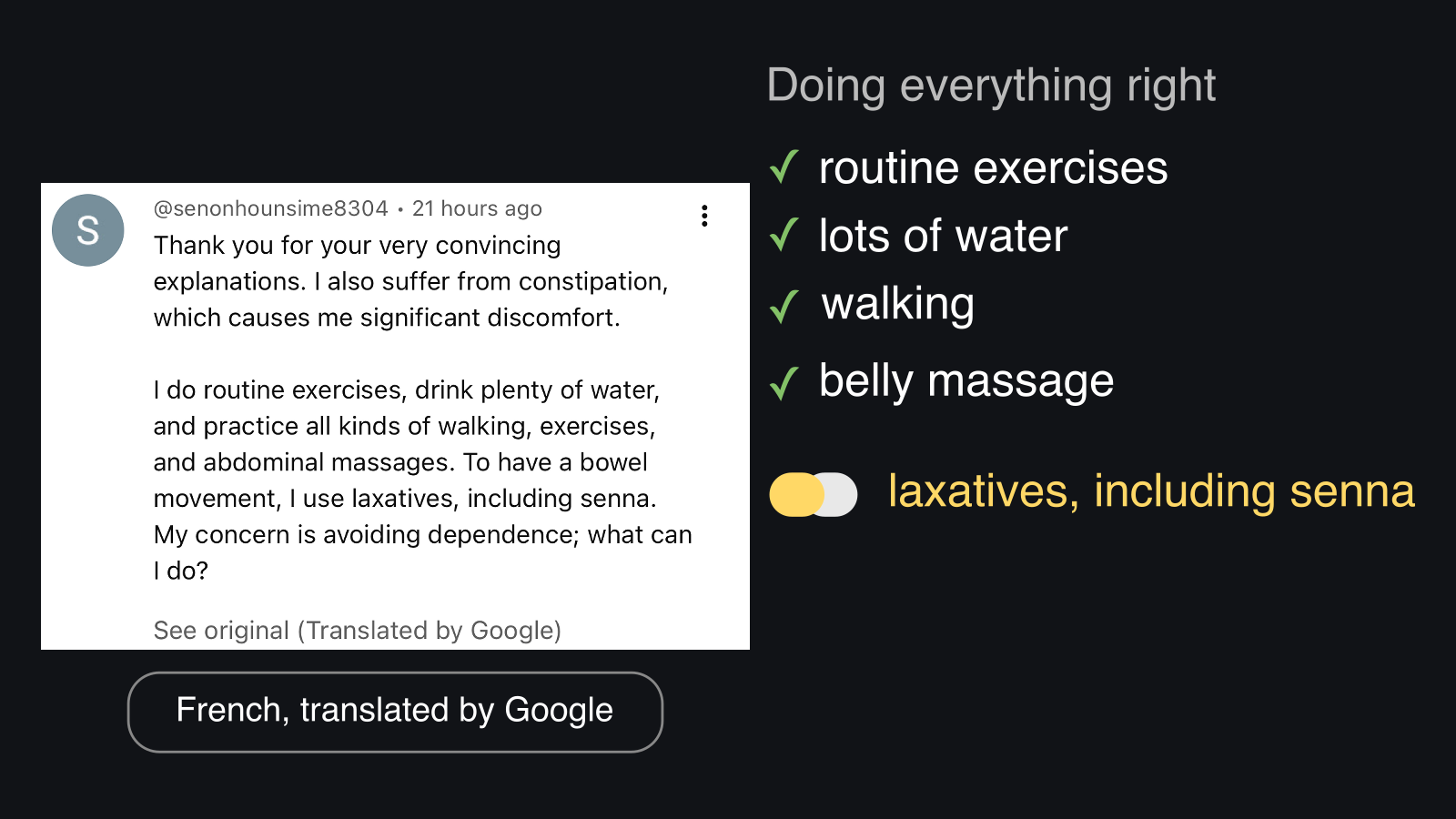
My worry is avoiding dependence. What can I do?
- Already trying
Routine exercises · water · walking · belly massage
- Still using
Laxatives, including senna
The complete translated comment appears immediately below this chart.
This guide began with one comment among 235 on an earlier explanation of how to poop fast, which had about 196,000 views. The reader wrote in French. Here is the English translation.
"Thank you for your very convincing explanations. I also suffer from constipation, and it leaves me in total discomfort. I do routine exercises, drink lots of water, do all kinds of walking and belly massage. To go, I use laxatives, including senna. My worry is avoiding dependence. What can I do?"
Here's what jumped out at me. Senna is a stimulant laxative. It makes your colon push, and that push is what finally gives you the urge to go. Now, everything on your list can help bring on the urge too. For a lot of people, a morning walk, warm water or a belly massage is enough. But for you, it isn't. That tells me your problem is stronger than what those habits can fix, so senna is filling the gap.
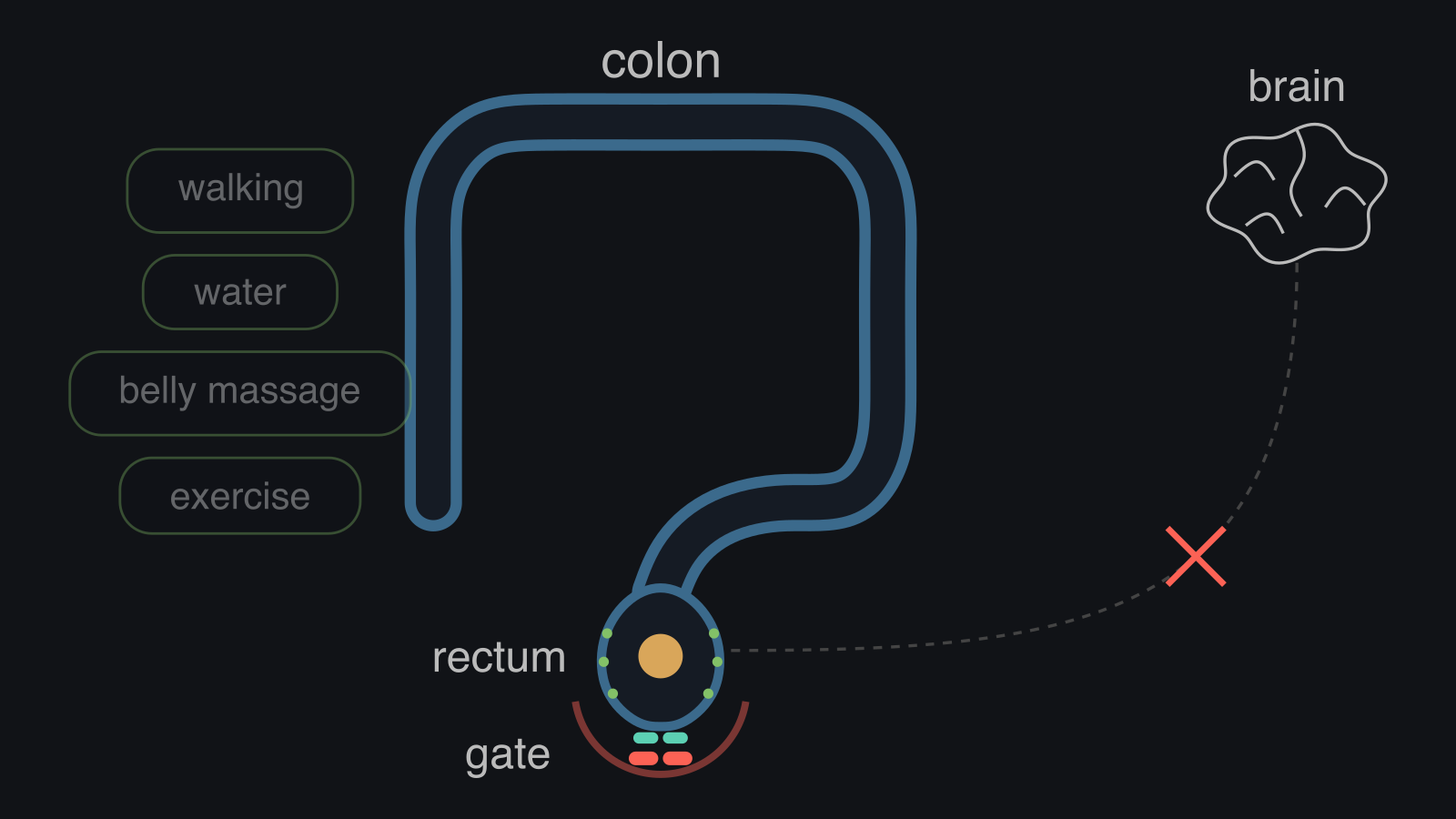

- Colon
- Rectum
- Outlet
- Stool moves through the colon
Walking, water, belly massage and exercise are the habits discussed here.
- The rectum receives stool
The article explains stretch and the urge signal.
- The brain notices an urge
Senna response is an observation, not a diagnosis.
So my guess is this: without senna, you don't feel the urge at all. If water, walking and massage were going to bring it back, they probably would have by now.
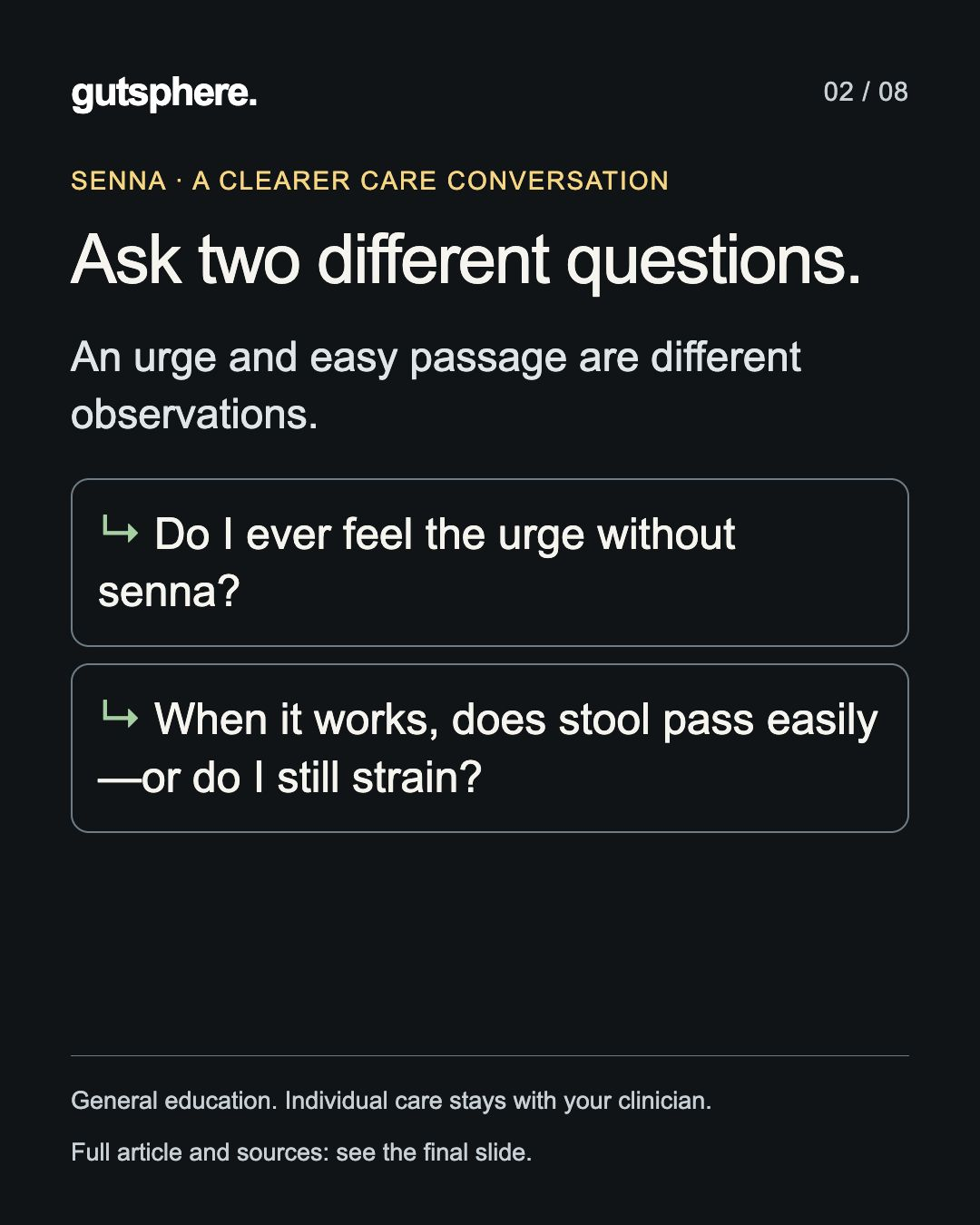
But I could be wrong, so let me ask you two questions. One: do you ever feel the urge without senna? Two: when senna works, does it come out easily, or do you still strain? Those are really different problems. No urge is one thing. An urge you can't act on is another. If you're in the same boat, ask yourself the same two questions. Whatever your answers are, this guide covers all three situations: no urge at all without senna; senna works and stool comes out easily; or you still strain, even on senna.
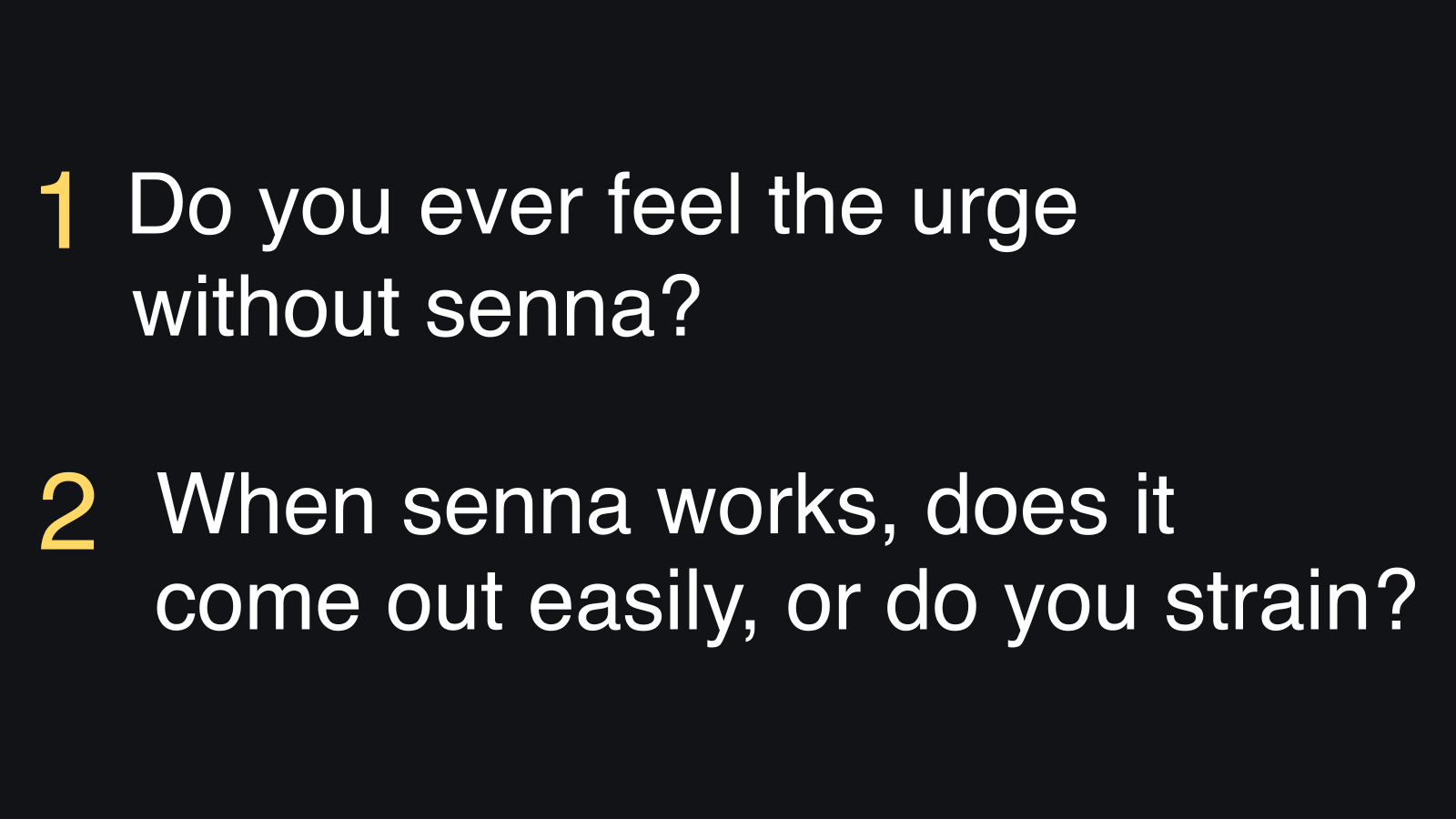
- 1 · Without senna
Do you ever feel the urge?
- 2 · When senna works
Does it come out easily, or do you still strain?
Here's what most people miss. Not having the urge is a symptom, not the root cause. And constipation like this rarely has just one cause. I know this from my own experience. It took me more than three years to realize I needed to look at it through a whole-person, multidisciplinary lens, not just gastroenterology. So I made it my mission to save you the thousands of hours of research and the years of suffering it took me.
Who this guide comes from, and the perspectives behind it
Now, a quick note on who I am. I'm Bimal, the founder of Gutsphere, and I've lived with chronic constipation myself. My role here is to connect published guidance across specialties and help you prepare better questions; your clinician assesses and treats your condition. Specialists go deep in one area. My job is to go wide. I'm the nerdy friend who reads the guidelines and the trials across all the specialties, connects them, and makes it simple enough to act on. Your doctor diagnoses and prescribes. I help you walk into that appointment with your pattern, the right questions, and a plan.
And I'm not here to invent anything new. Everything in this guide already exists, in guidelines and trials. My job is to make it actionable, accessible and affordable. I synthesize, structure and simplify, so you can act.
This guide brings together several perspectives rather than one lens or one fix. We'll look at it as if you had a whole care team: gastroenterology, neurogastroenterology, which is the gut-brain side, the pelvic floor, psychology, nutrition, pharmacy, movement, stress and sleep. The relevant perspective is identified throughout.
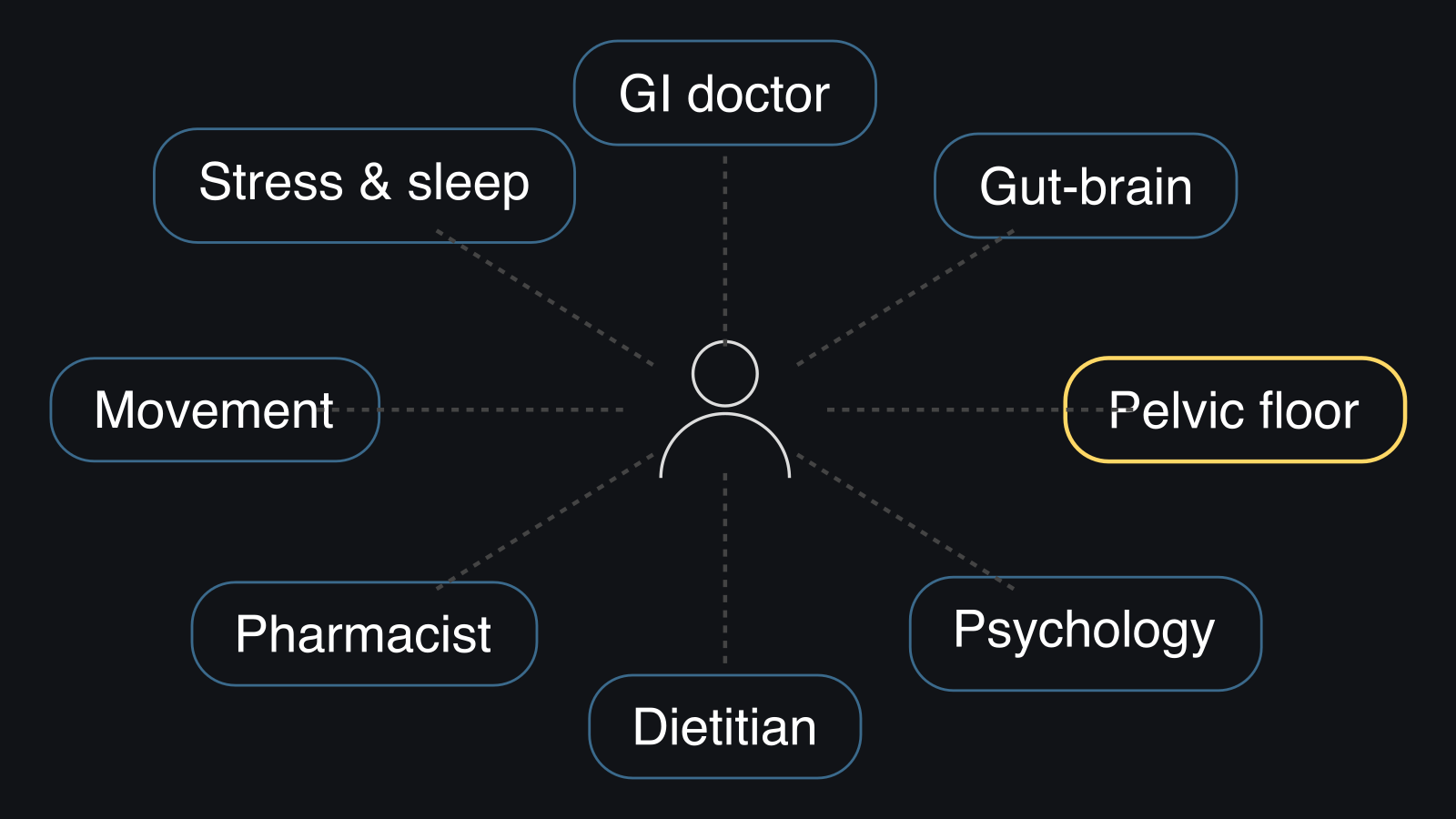
- Gastroenterology
GI doctor
- Neurogastroenterology
Gut–brain signals
- Pelvic floor
Coordination and evacuation
- Psychology
Habits and context
- Dietitian
Food and fiber
- Pharmacist
Medicines and review
- Movement
Activity
- Stress and sleep
Daily context
These are perspectives in the research, not an eight-person clinical team reviewing this article.
Author: Bimal, founder of Gutsphere. No clinical reviewer is represented by this illustration.
Through those lenses, I'll help you identify your root causes: how to spot yours from your own patterns, and how to confirm it with your doctor. Then I'll give you a structure to get the urge back, by targeting those root causes. And a way to reduce your dependence on laxatives. Tapering off safely. No cold turkey.
The aim is to turn information into action and build momentum. Most steps in this structure have a guided routine you can follow: pelvic floor routines, nutrition routines, gut-brain routines such as breathing and meditation, and more. The routines are named alongside the relevant steps, with companion resources listed at the end of this guide.
Whether it works for you or not, you'll know. You can run the whole plan in the gutsphere app and build your own evidence as you go.
For every step, the evidence is described as strong, moderate, or limited. Source material is listed at the end of this guide. And none of this replaces your prescriptions or a diagnosis. It works alongside them.
Grab something to write on. Two numbers from last week: how many days did you take a laxative, and on how many did you feel a real urge without one? That's your starting point.
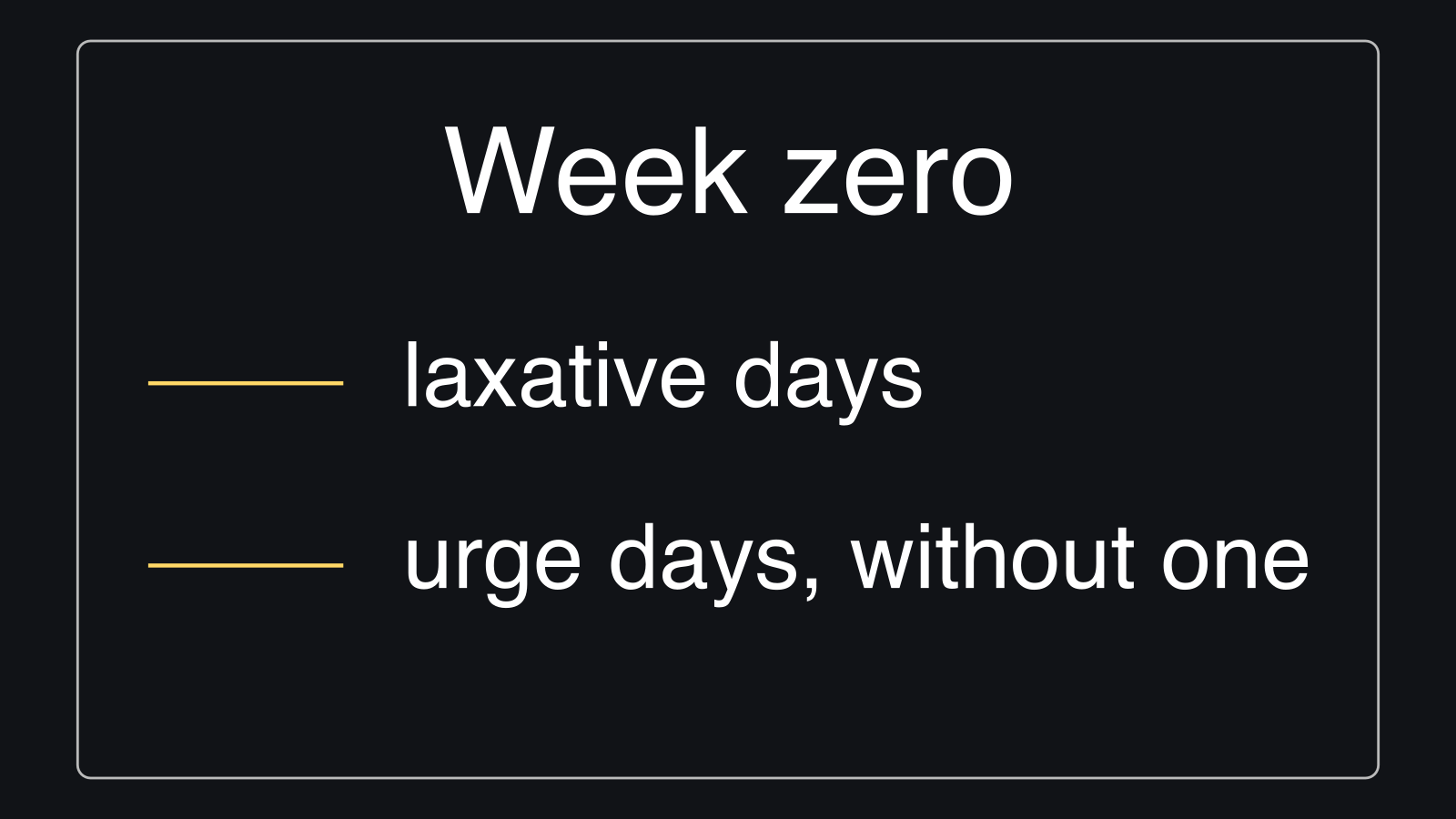
- Laxative days
How many days last week?
- Urge days, without one
How many days last week?
But first, some fear, uncertainty and doubt about laxatives, especially senna. If you're worried you're damaging your colon, that worry deserves a straight answer.
Fear: is senna damaging my colon?
So, the fear. Is senna hurting your colon? Let's see what the gut doctors say.
First, I get where the fear comes from. It's not made up. Look at the box. Senna labels say don't use it for more than a week unless your doctor tells you to. Health sites like the NHS warn that long-term use can stop your bowel working on its own. When you read that every morning, of course you worry.
Sources: MedlinePlus: senna.
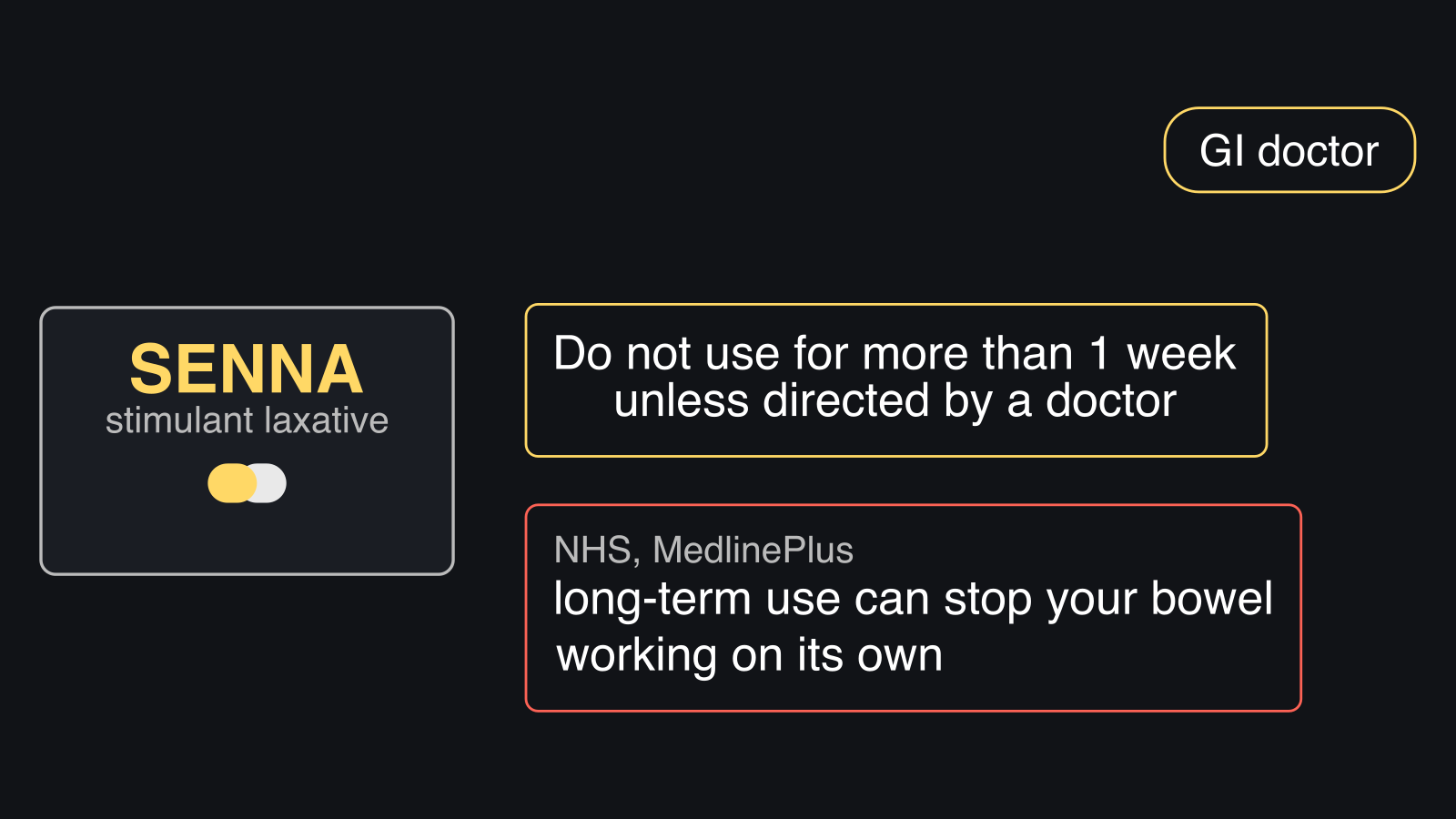
- Senna
A stimulant laxative.
- The label warning
Do not use for more than one week unless directed by a doctor.
- The concern
NHS and MedlinePlus warnings raise questions about continued use.
The article below explains how self-treatment warnings and clinician-directed use differ.
But here's what that warning really means. It's written for people treating themselves. It's saying: if you need this for more than a week, someone should figure out why. Not: this is poisoning you.
Part of the fear is history. Years ago, some laxatives really were a problem. In 1999, the FDA pulled two old ingredients, including the one in the original Ex-Lax, after cancer findings in animal studies. Ex-Lax switched to senna. And a few old studies seemed to show changes in the colons of long-term users. So people learned to be scared of all laxatives.

- 1999 · FDA
Phenolphthalein and danthron were removed after safety concerns.
- Ex-Lax and senna
The article discusses the change from an older ingredient to senna.
The original chart’s date axis runs from 1990 to 2022; this is historical context, not a senna dose or duration guide.
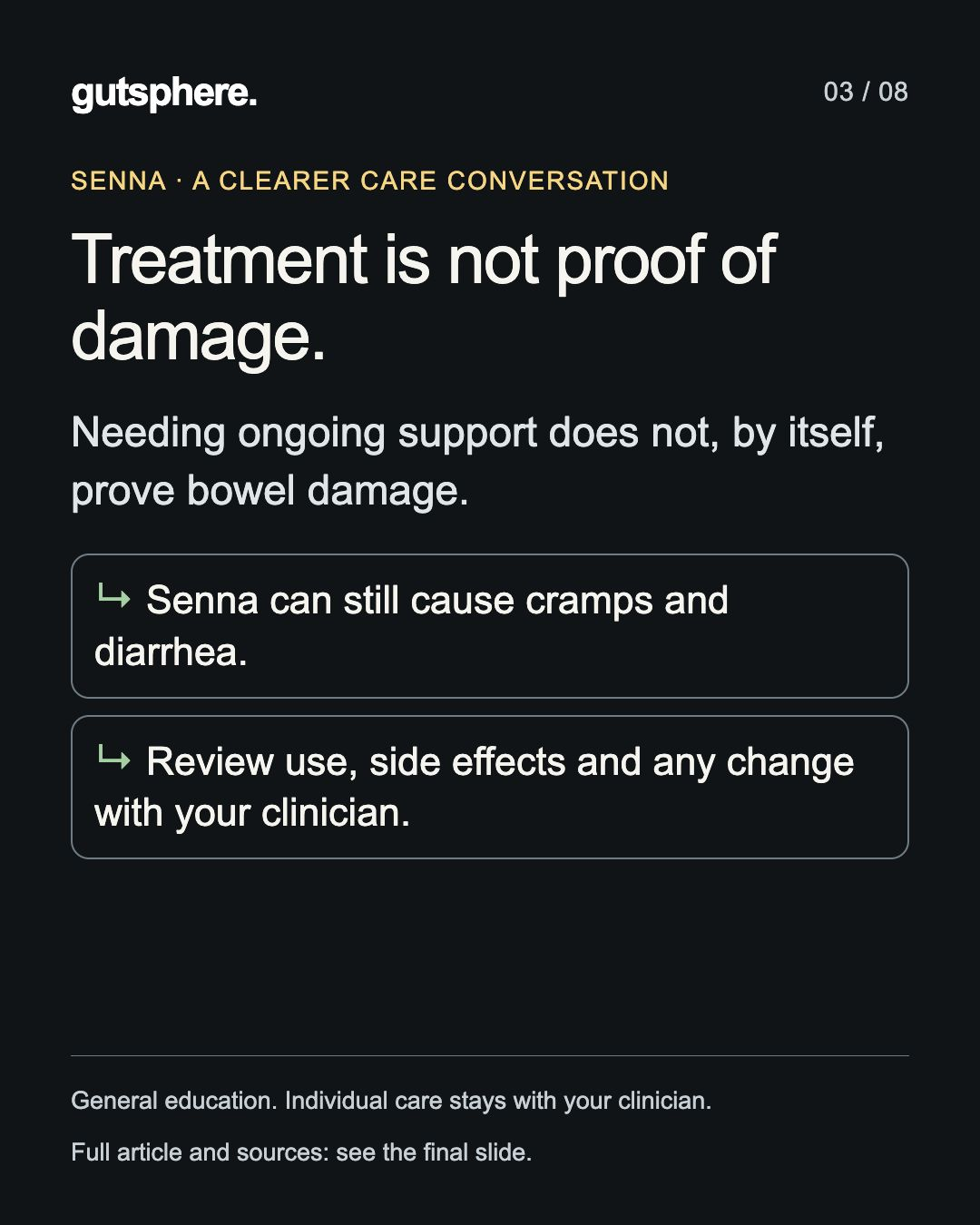
Now, the good news. Reviews of the available research have not found convincing evidence that senna at recommended doses damages the colon. One review summarized more than 70 publications describing 240 cases of stimulant-laxative abuse without reported cathartic colon. That finding does not prove that every pattern of use is safe. Senna can cause cramps and diarrhea. Excessive use or prolonged diarrhea can also disturb electrolytes, including potassium. So stick to the label dose unless your doctor says otherwise.
Sources: Stimulant-laxative safety review, 2024 · NHS: senna uses and side effects.
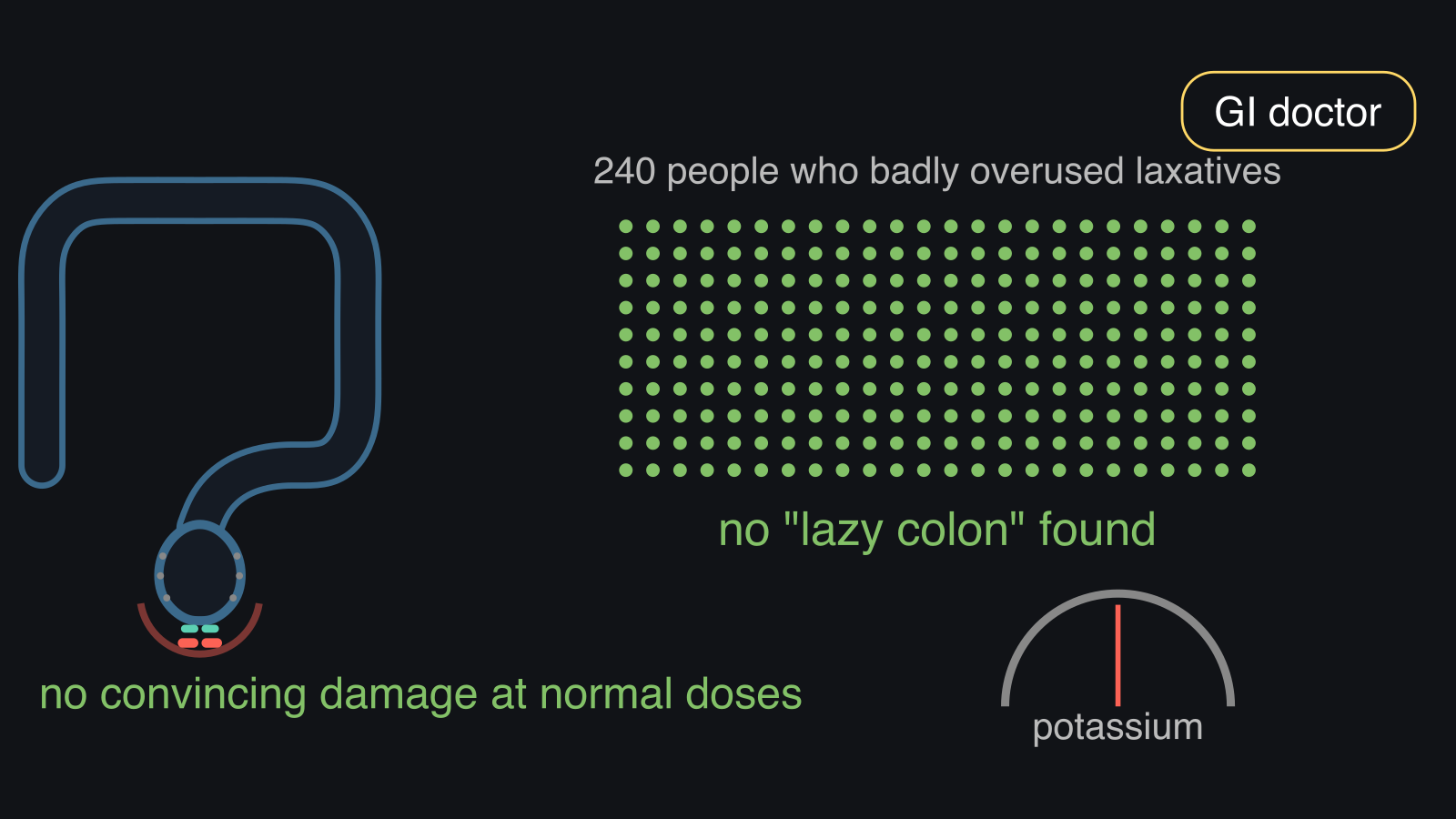
- Colon
- Rectum
- Outlet
- Recommended doses
Available research has not established convincing colon damage.
- 240 reported cases
A review summarized stimulant-laxative abuse reports without reported cathartic colon.
- Limits and risks
This does not prove every use pattern is safe. Cramps, diarrhea and electrolyte disturbance, including potassium loss, remain relevant.
Earlier this year, the American Gastroenterological Association said it plainly: those old worries about long-term use are unfounded.
Sources: AGA refractory constipation update, 2026.
So what does dependence really mean? Your colon probably didn't get lazy. Whatever made you need senna in the first place is still there. Stop senna, and that problem shows up again. That's what we're going after.
Uncertainty: stay on it, or step down?
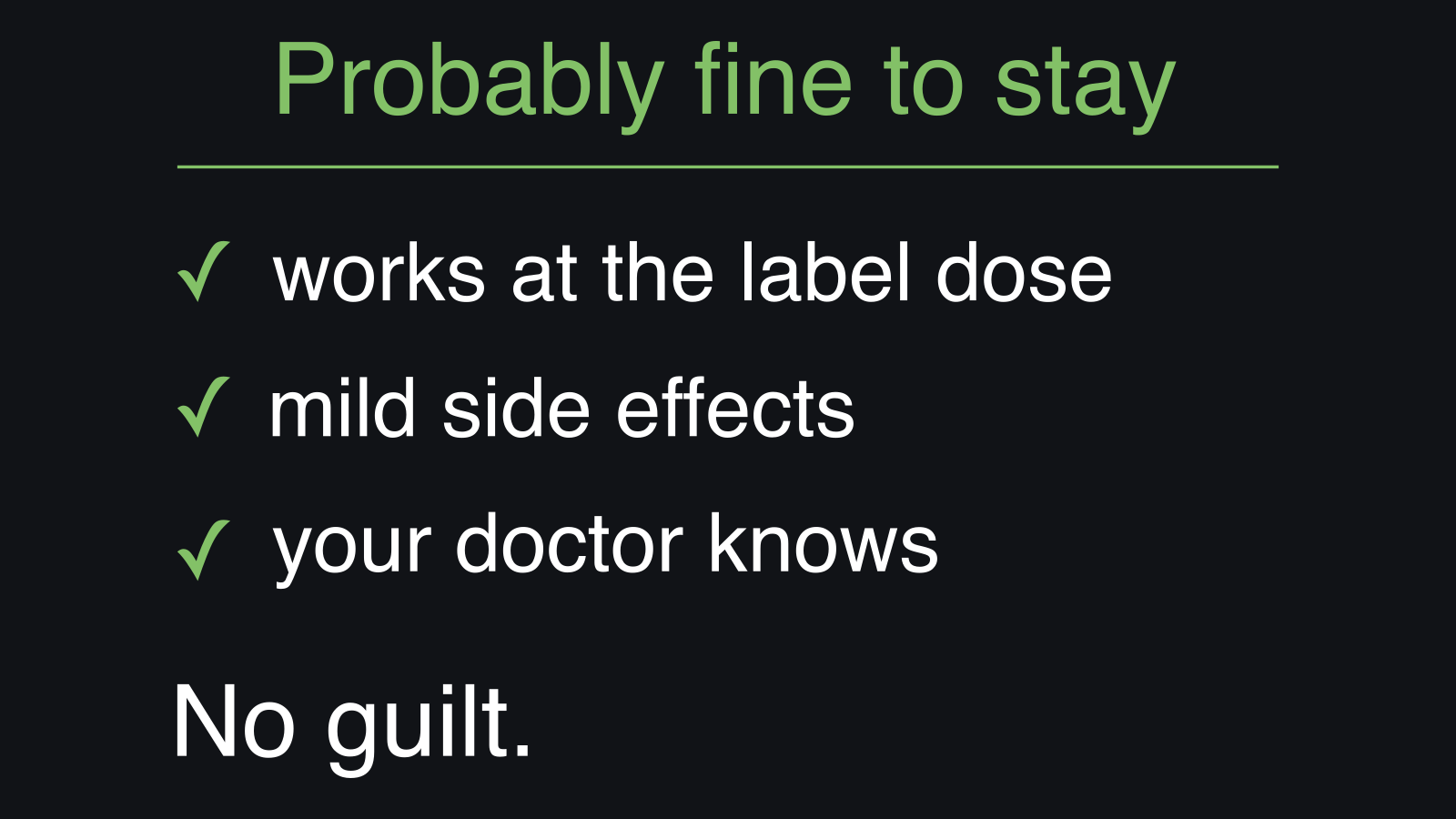
- Works at the label dose
One observation to discuss.
- Side effects are mild
Review any effects with your clinician.
- Your doctor knows
Individual advice still applies.
No guilt. Continuing appropriate support can be a valid outcome; the article explains the limits.
Next, the uncertainty. Is it okay to keep taking it?
Here's where the guidelines land. US gut doctors list senna as an acceptable option for long-term constipation. Not their top pick, and the evidence behind it isn't strong, but acceptable. Start low, they say.
Sources: AGA–ACG guideline, 2023.
There's no official rule for when to stay on it and when to step down. So here's a simple way I think about it.
If senna works at the label dose, the side effects are mild, and your doctor knows you take it, staying on it is okay. No guilt.
That said, I'll be honest about my own bias. Even when the evidence says a medicine is safe, I'd rather not take one I don't need. And I think most people feel the same way. So wanting to need less senna, or none at all, is a fair goal. Just do it only when it's safe, and with your doctor.
But it's worth stepping down, with your doctor, if any of these sound like you. You keep needing more. You get cramps, sudden urgency or loose stools. You still strain, even on senna. Or you've been on it for months, and nobody has asked why.
Our friend is in total discomfort, so I'd put him in the second group. Zero isn't required. The goal is getting the urge working again, and letting your body show you how much senna you still need. If that turns out to be none, great.
Why water, walking and massage may not be enough
Now the doubt. You've tried the natural stuff. Will anything work for you?
Let's look at your routine together, the way your care team would.
Water first. A dietitian would tell you something surprising: water works best as fiber's partner. When people eating plenty of fiber drank more water, they went more often and needed fewer laxatives. But extra water on its own, in people who already drink enough, didn't do much. So if you already drink plenty, more water alone probably won't change things.
Sources: Anti and colleagues: water plus fiber trial, 1998.
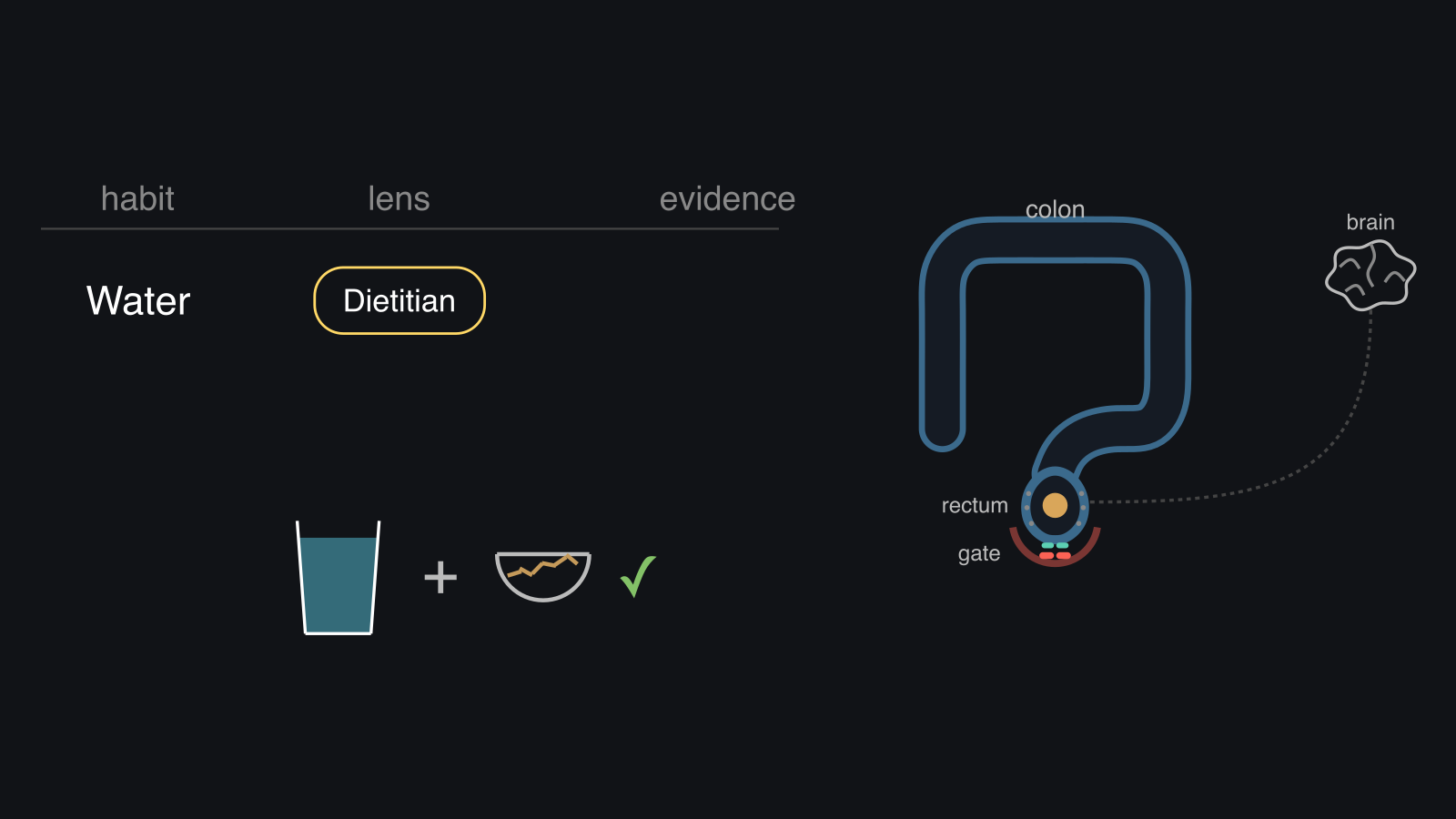
- Habit
Water
- Research perspective
Dietitian
- Relationship shown
Water + fiber
- Teaching limit
This does not show that extra water alone restores an urge.
- Colon
- Rectum
- Outlet
Walking and exercise: keep doing it. In studies, people who exercised were about twice as likely to improve, and walking-type exercise did best. The studies weren't perfect, so I'd call it moderate evidence. But walking is a keeper.
Sources: Exercise systematic review, 2019.
Belly massage: if you enjoy it, keep it. The studies are small, mostly in people with other conditions who were also taking laxatives. So, limited evidence. Nice to have, not a fix.
Sources: Kayıkçı and colleagues: abdominal massage review, 2020.
So your routine isn't wrong. For a lot of people, it's enough to bring on the urge. But it all works on one thing: getting stool moving and triggering the colon. If your problem is more severe, or it sits somewhere else, like a signal you don't feel or an exit that won't open, those habits can't reach it. And nobody on that list is a pelvic floor therapist.
Sources: Rao and colleagues: biofeedback trial, 2007.
So, will anything work for you? There's a real chance, yes. What you've tried works on one root. If yours is a different one, there are things that target it directly. Some, like biofeedback for the exit, help 70 to 80 percent of people in trials.
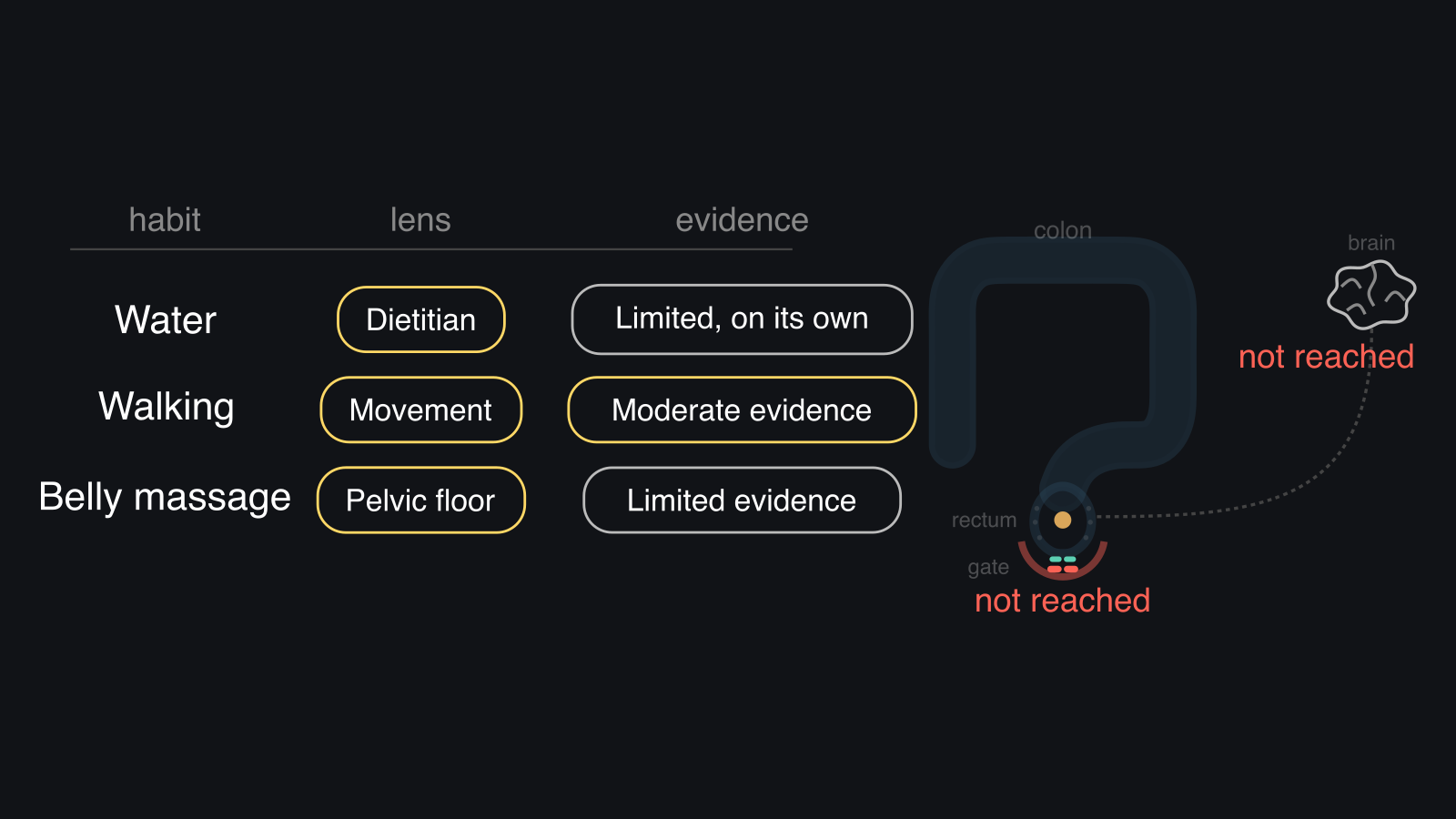
- Water · dietitian
Limited on its own.
- Walking · movement
Moderate evidence in the source discussion.
- Belly massage · pelvic floor
Limited evidence in the source discussion.
- Colon
- Rectum
- Outlet
These habits may not address every signal or evacuation problem. Evidence labels refer to the source discussion, not a product trial.
Why might you have no urge without senna?
Okay, let's go one level deeper, with the gut-brain specialists. Doctors now see constipation like this as a gut-brain problem. It's not just a slow pipe. It's about how your gut and your brain talk to each other. And the urge is the best example.
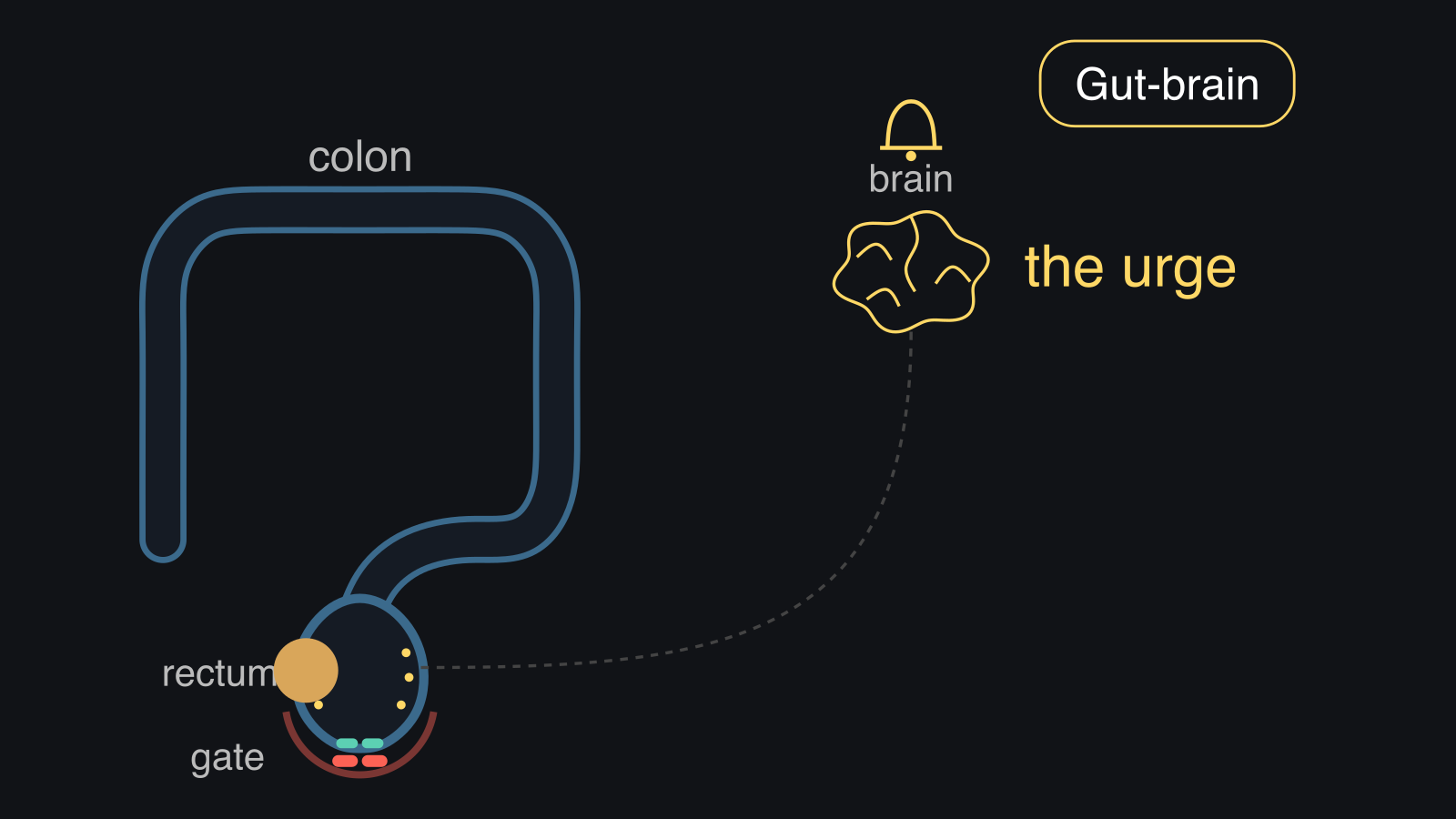
Here's how it's supposed to work. Stool arrives at the end of your colon, the rectum. The rectum stretches, a bit like a balloon filling up. Nerves send a message to your brain: time to go. That's the urge. Think of it like a doorbell. When the urge goes missing, the doorbell isn't ringing. And there are three reasons that can happen.
- Colon
- Rectum
- Outlet
- Stool arrives
The rectum stretches.
- A signal travels
The brain notices an urge.

- Brain · awareness of the urge
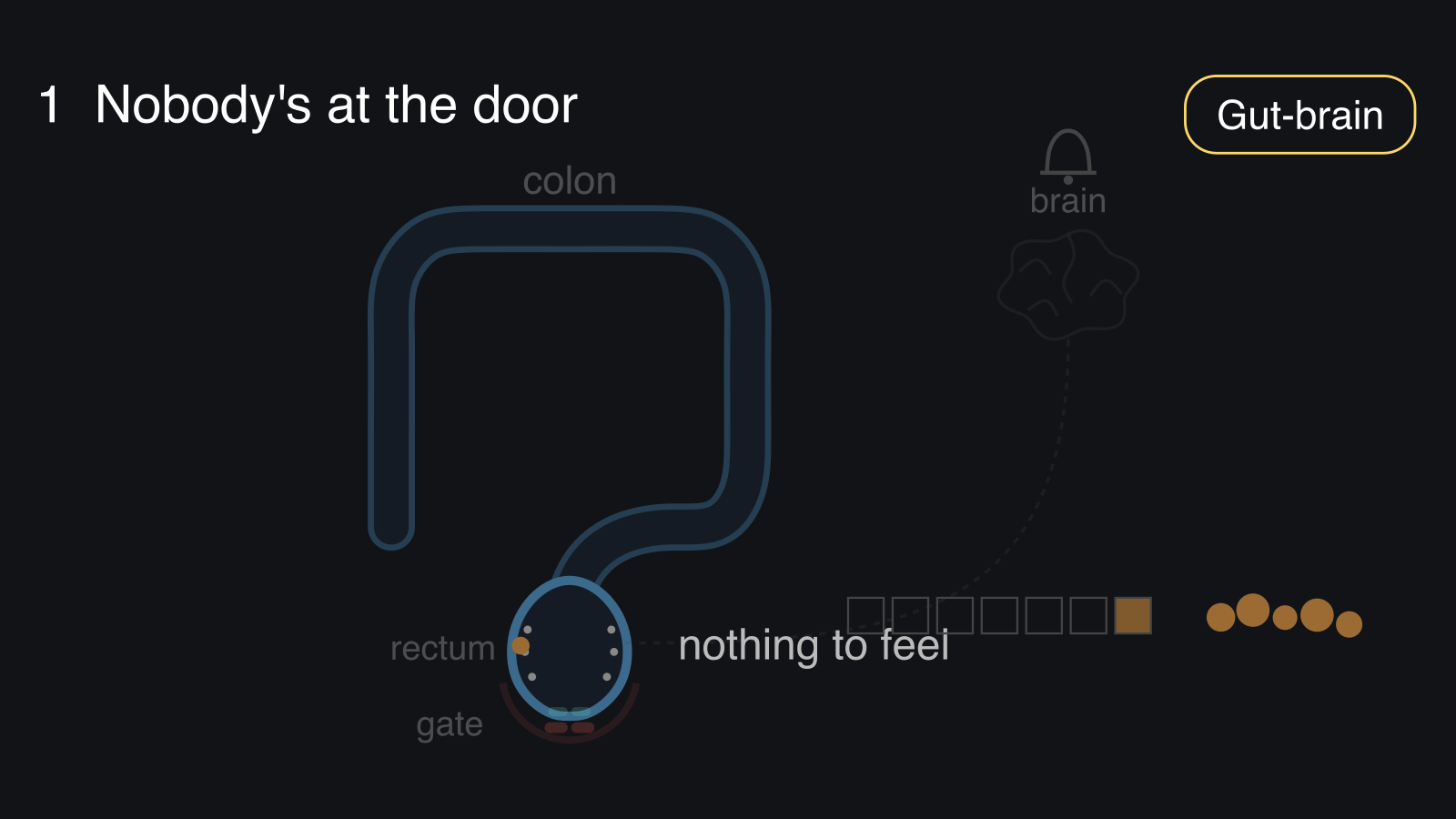
One: nobody's at the door. Nothing is arriving. Your colon isn't pushing much, or your stool doesn't have enough bulk to stretch the rectum. So there's nothing to feel. You go days without feeling full, and when something does come, it's small and hard.
- Colon
- Rectum
- Outlet
- Little stool arrives
There may be little stretch to notice.
- Little signal is felt
This is one possibility discussed in the article, not a home diagnosis.
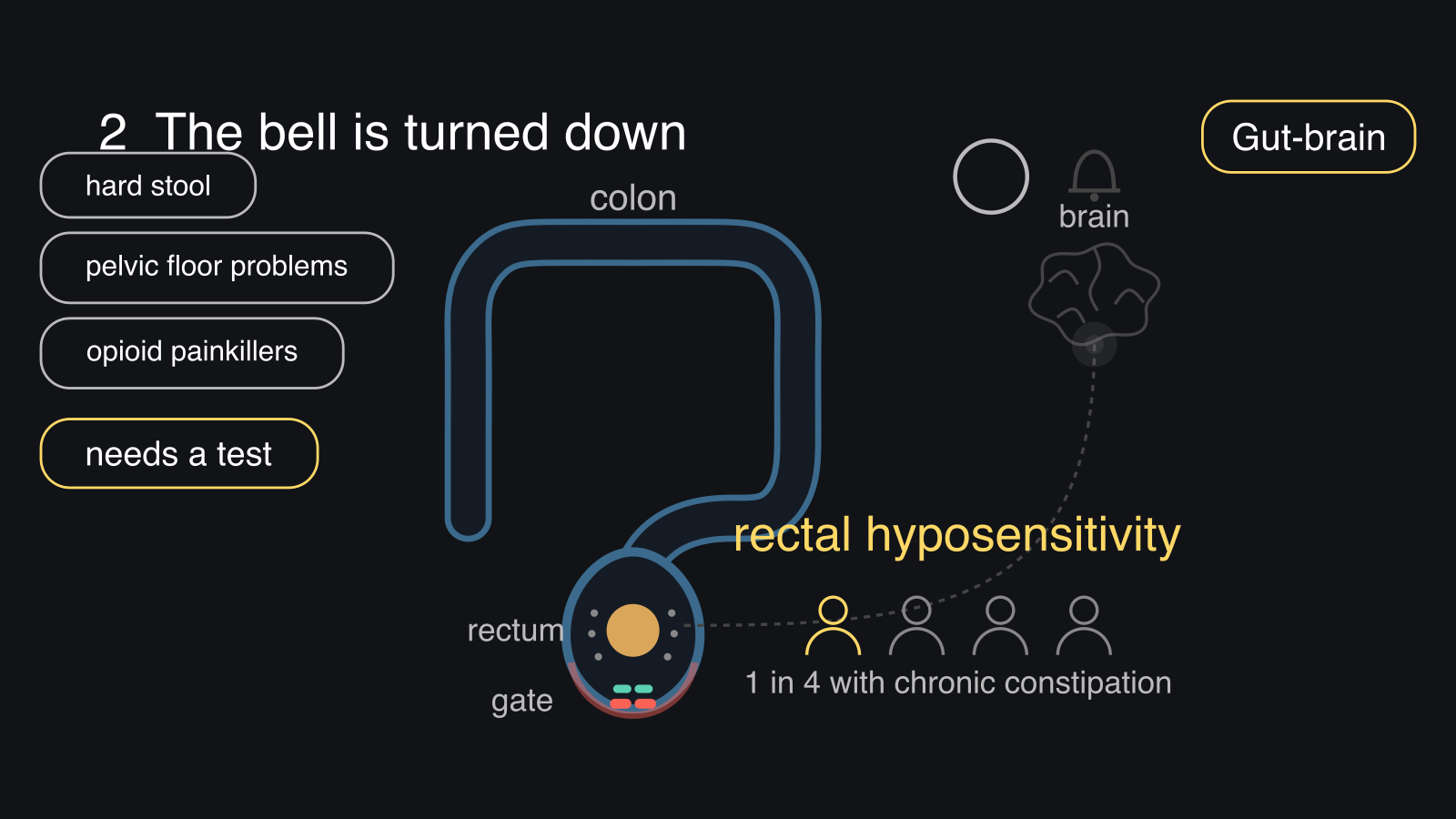
Two: someone's at the door, but the bell is turned down. The rectum fills up, but you don't feel it. Doctors call this rectal hyposensitivity. It's more common than you'd think: about one in four people with chronic constipation. It's linked to hard stool, to pelvic floor problems, and to some medicines, like opioid painkillers. You can't confirm this one at home. It takes a test.
- Colon
- Rectum
- Outlet
- The bell is turned down
The article calls this rectal hyposensitivity.
- Factors discussed
Hard stool · pelvic-floor problems · opioid painkillers
- Source prevalence statement
About 1 in 4 people with chronic constipation.
- Needs assessment
You cannot confirm it at home; it takes a test.
Three: the bell rings, but you've learned to ignore it. Years of "not now." Busy mornings, work, being out of the house. Pelvic floor therapists say holding it in trains your pelvic floor to tighten instead of relax. After a while, your body stops ringing. From the psychology side, that's a learned habit. And the good news is, anything your body learned, it can relearn.
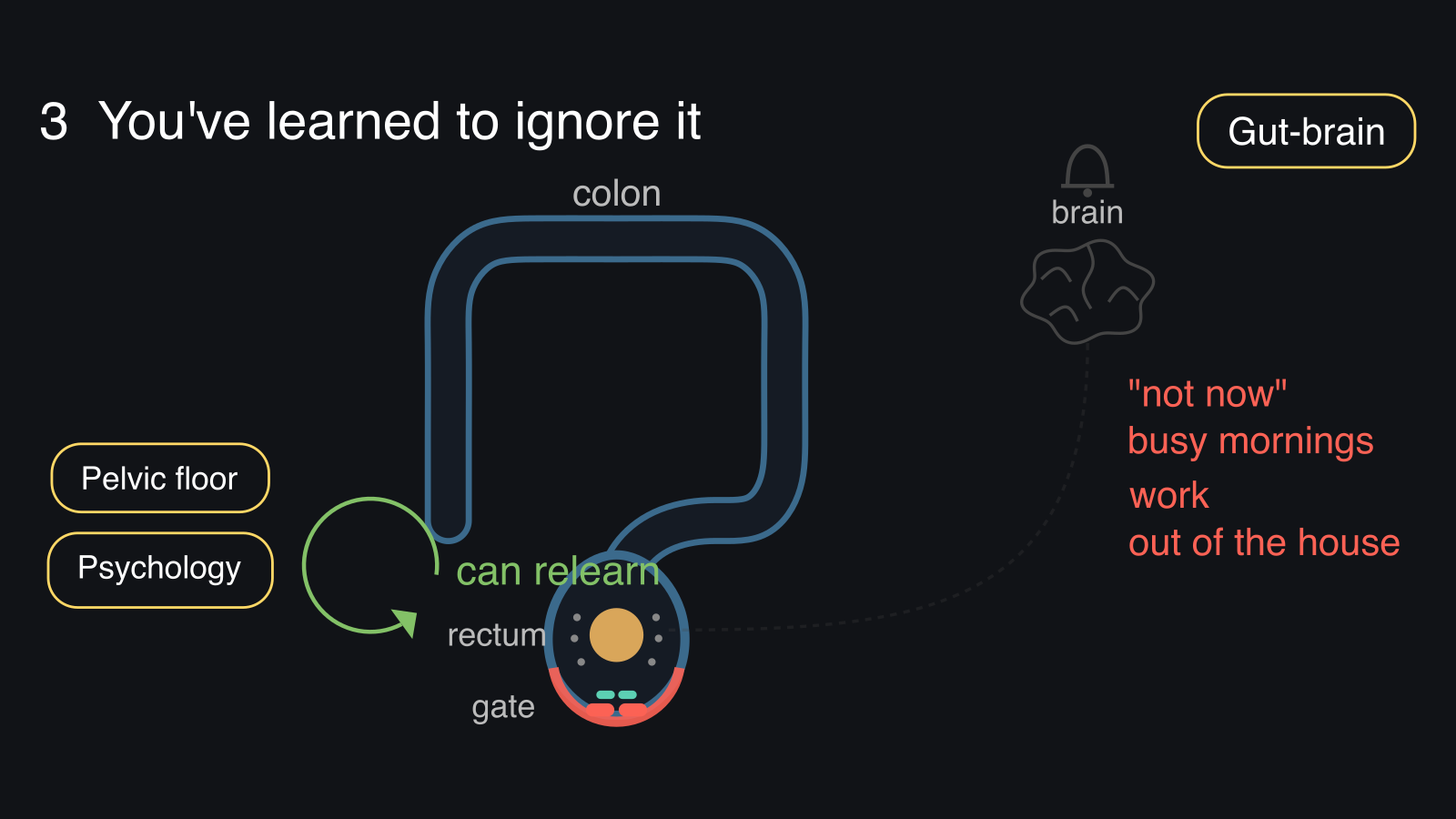
- Colon
- Rectum
- Outlet
- “Not now”
Busy mornings · work · out of the house
- A habit to discuss
The article considers postponing from pelvic-floor and psychology perspectives.
The source frames this as something that can be relearned; individual causes still need assessment.
Then there's a different problem. The doorbell rings, or senna rings it for you, but the door won't open. You strain, you shift around, you never feel empty. That's not the urge. That's the exit.
Your pelvic floor muscles are supposed to relax when you push. In some people, they tighten instead. Like a bouncer holding the door shut. It's called dyssynergia. It's something your body learned, not something broken. And it's really common: somewhere around 40 to 50 percent of people who end up at a specialist for constipation have it. No amount of water or walking opens that door.
So here's what your second answer tells you. If senna works and it comes out easily, that's useful information. But easy passage after senna does not rule out a pelvic-floor or evacuation problem. Roots one to three are possibilities to discuss when the urge is missing. If you still strain, even on senna, the exit moves higher on your list of questions. Persistent straining, blockage or incomplete emptying deserves assessment. And often one of the doorbell problems comes along with it. That's my reading of the research, not a diagnosis, but it's a place to start the conversation.
Sources: AGA: refractory constipation patient guide.
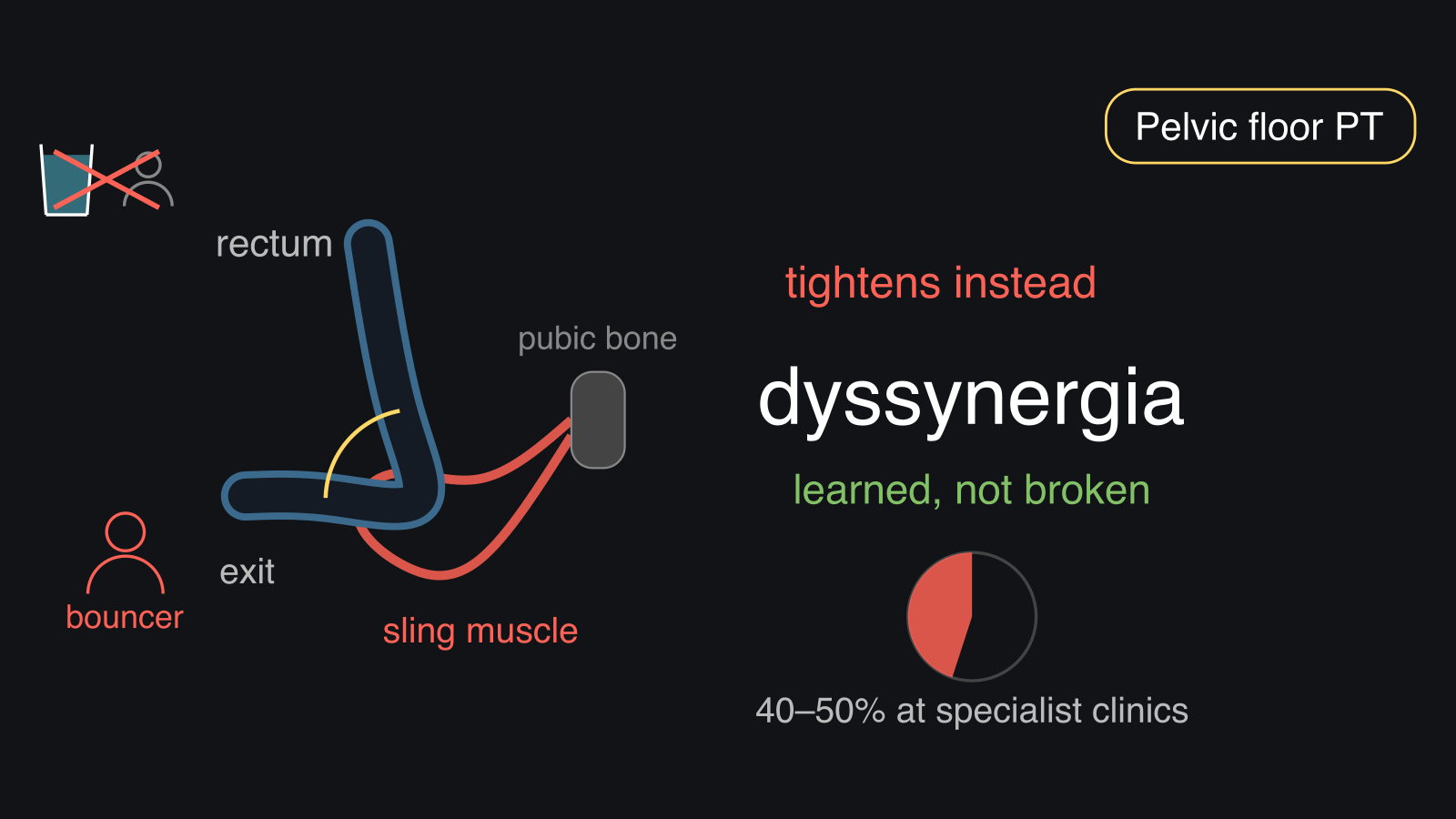
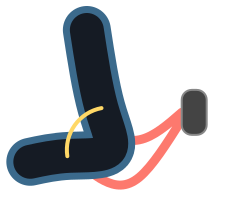
- Rectum
- Pubic bone
- Sling muscle
- Exit
- Dyssynergia
The muscles may tighten instead of coordinating relaxation.
- Source prevalence statement
40–50% in specialist constipation clinics.
- Teaching limit
The drawing is simplified; symptoms alone do not establish this diagnosis.
Two more things can make all of this worse. Some medicines, like opioid painkillers, iron, and some medicines for mood, sleep, allergies or psychosis. They're one of the most common causes of constipation. And stress and sleep. Stress may tighten your pelvic floor, though that's still being studied. And in a big US survey, people who slept too little were more likely to have chronic constipation. Another study found it was short sleep for men and long sleep for women. That's a link, not proof that fixing sleep fixes it.
Sources: NIDDK: constipation symptoms and causes.
Most people have a mix. So how do you figure out yours?
Two standalone tools
Prepare a clearer care conversation.
Use the tools online, or use their existing email form for a blank fillable PDF. Your online entries are not sent with the download request.
What to record: a quick check and two-week log
I'll give you two simple tools. A quick check you can do right now, and a log for the next two weeks.
The quick check. Just answer yes or no.
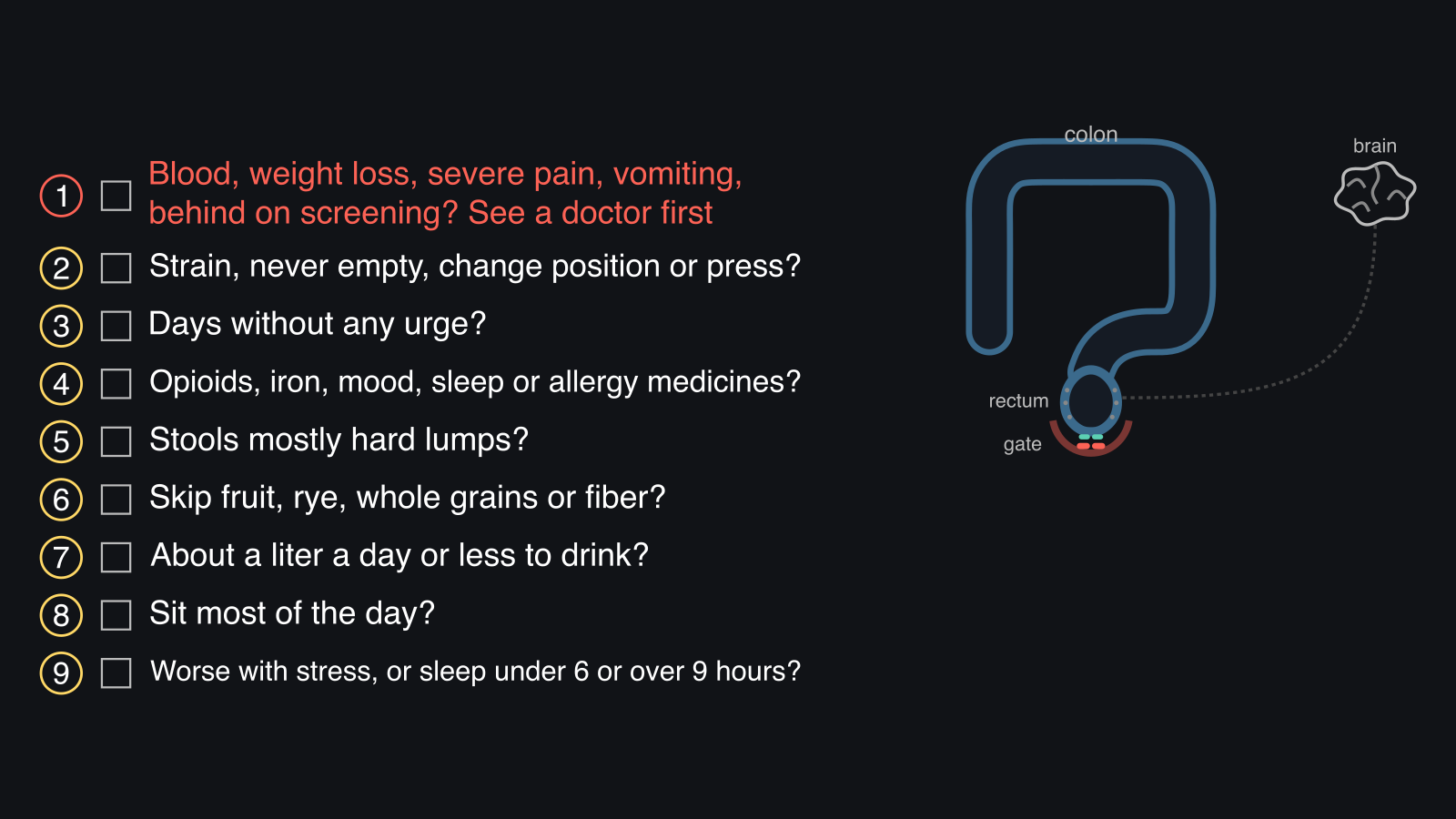
- Blood, unexplained weight loss, severe pain, vomiting, or behind on screening? See a doctor first.
- Straining, incomplete emptying, changing position or pressing?
- Days without any urge?
- Opioids, iron, mood, sleep or allergy medicines?
- Mostly hard, lumpy stools?
- Often skip fruit, rye, whole grains or fiber?
- About a liter a day or less to drink?
- Sit most of the day?
- Worse with stress, or sleep under six or over nine hours?
An organizing tool, not a diagnostic test or validated score. The complete questions and interpretation remain below.
- One: blood in your stool, weight loss you can't explain, severe pain, vomiting, or behind on colon cancer screening? If yes, stop here and see a doctor first.
- Two: do you strain, never feel fully empty, or need to change position or press to get it out?
- Three: do you go days without feeling any urge?
- Four: do you take opioids, iron, or medicines for mood, sleep or allergies?
- Five: are your stools mostly hard lumps?
- Six: do you skip fruit, rye or whole grains, or a fiber supplement most days?
- Seven: do you drink about a liter a day or less?
- Eight: do you sit most of the day?
- Nine: is it worse when you're stressed, or do you usually sleep under six or over nine hours?
Your yeses are your starting map. Question two points to the exit. Three, to the urge. Four, to your medicines. Five to seven, to food and drink. Eight, to movement. Nine, to stress and sleep. For our friend, my guess is the urge, maybe hard stool, and maybe the exit. And just so you know, I built this from the research. It's a map, not a medical test.
Now the log. For two weeks, every day, jot down four things.
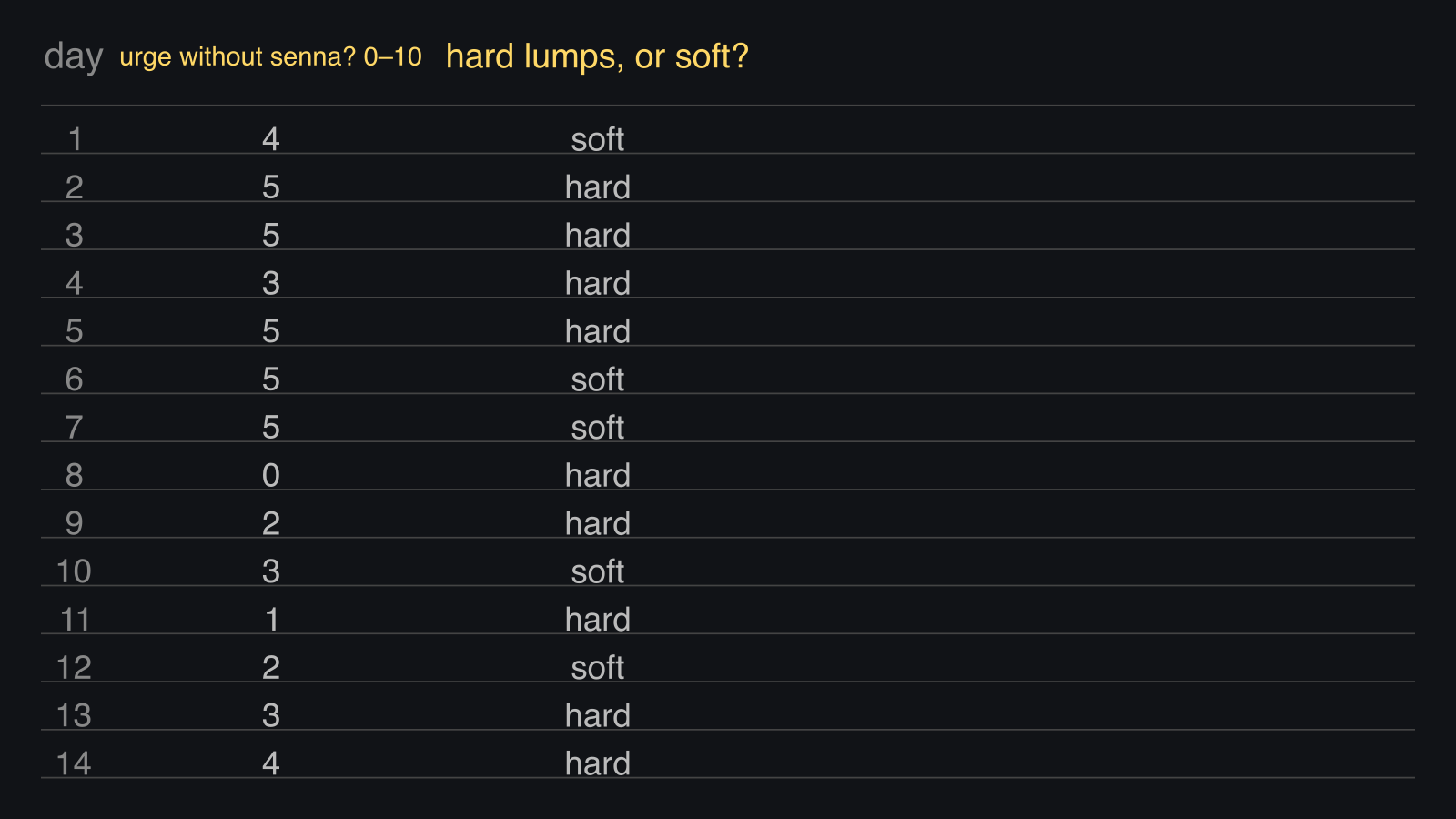
| Day | Urge 0–10 | Stool |
|---|---|---|
| 1 | 4 | soft |
| 2 | 5 | hard |
| 3 | 5 | hard |
| 4 | 3 | hard |
| 5 | 5 | hard |
| 6 | 5 | soft |
| 7 | 5 | soft |
| 8 | 0 | hard |
| 9 | 2 | hard |
| 10 | 3 | soft |
| 11 | 1 | hard |
| 12 | 2 | soft |
| 13 | 3 | hard |
| 14 | 4 | hard |
Illustrative entries from the original chart, not patient results. The log fields below also ask about ease of passage and postponing an urge.
| Record | What to note |
|---|---|
| Date and treatment | Date; whether it was a senna or other laxative day, and treatment taken as agreed. |
| Urge without senna | Yes or no; strength from 0 to 10. |
| Stool consistency | Hard lumps, or soft and easy? |
| Ease of passage | On senna days: easy passage, or straining? |
| Postponing an urge | Did you feel an urge and put it off? |
One: did I feel an urge without senna? Yes or no, and how strong, zero to ten. Two: was my stool hard lumps, or soft and easy? Three: on senna days, did it come out easily, or did I strain? And four: did I feel an urge and put it off?
Then read it. Urges you put off: root three. Few, small, hard stools and almost no urge: start with root one. Straining even on senna: the exit. Days with no signal at all, even when you know you're backed up: ask your doctor about root two.
The log won't diagnose you. But it turns "I'm constipated" into a pattern your doctor can actually work with. The example above shows the format, and the gutsphere app can track it for you.
Confirm it with your doctor
First, a quick safety check before you change anything. Please see a doctor first if any of these apply. Blood in your stool. Anemia. Weight loss you can't explain. Severe belly pain, or vomiting. A swollen belly with no bowel movement. Constipation that's new, or getting worse. Constipation that started with a new medicine. Or you're behind on colon cancer screening. Same if you're pregnant. And this plan is for adults.
Sources: NIDDK: constipation symptoms and causes.
Then take your check and your log to your doctor. A one-page doctor sheet brings them together; its link will be added to the companion resources below. Here's what to ask.
One: ask your pharmacist or doctor to look at every medicine you take. This one has strong evidence. Medicines are one of the most common hidden causes.
Two: ask your gut doctor about testing, if you still strain even on senna, or if nothing changes by week six. US guidance says people who don't get better with laxatives should be offered two tests: anorectal manometry and a balloon expulsion test. And this year, the American Gastroenterological Association went further. They said most people with chronic constipation should be tested before anyone calls it "hard to treat." Because a missed pelvic floor problem is one of the most common reasons people stay stuck.
Sources: AGA refractory constipation update, 2026.
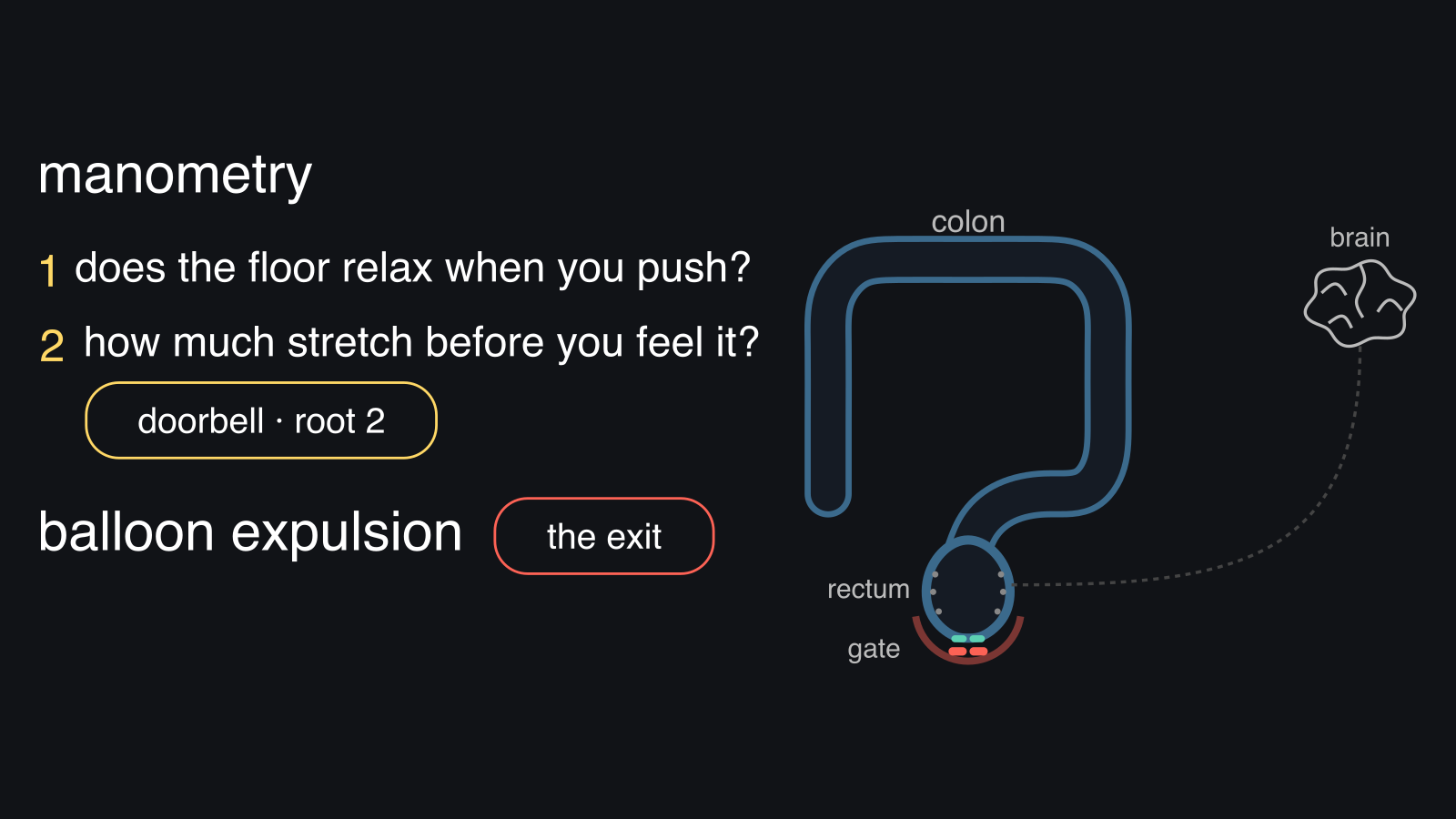
- Anorectal manometry
Does the pelvic floor relax when you push? How much stretch before you feel it?
- The “doorbell” question
Sensation is part of the assessment.
- Balloon expulsion
Can you pass the test balloon? This assesses evacuation.
- Colon
- Rectum
- Outlet
These tests sound scary, but they're simple. Manometry uses a thin sensor and a small balloon. It checks two things: does your pelvic floor relax when you push, and how much stretch does it take before you feel the urge? That second part is your doorbell, root two. The balloon test is just what it sounds like: can you push out a small water-filled balloon? That's the exit. And if those look normal, the next step is usually a transit test, to see whether your colon itself is slow. That's root one.
Sources: AGA: refractory constipation patient guide.
Here's why it's worth it. Every result points to a real treatment. If it's the exit, there's biofeedback. You practice relaxing and pushing while a sensor shows you what your muscles are actually doing. In trials, 70 to 80 percent of people who hadn't improved with usual treatment got much better, and most kept it up. There's even a home version that worked as well as the clinic one in a trial. That's strong evidence. Seventy to eighty percent. That's a big deal.
Sources: Rao and colleagues: biofeedback trial, 2007 · Home versus office biofeedback trial, 2018.
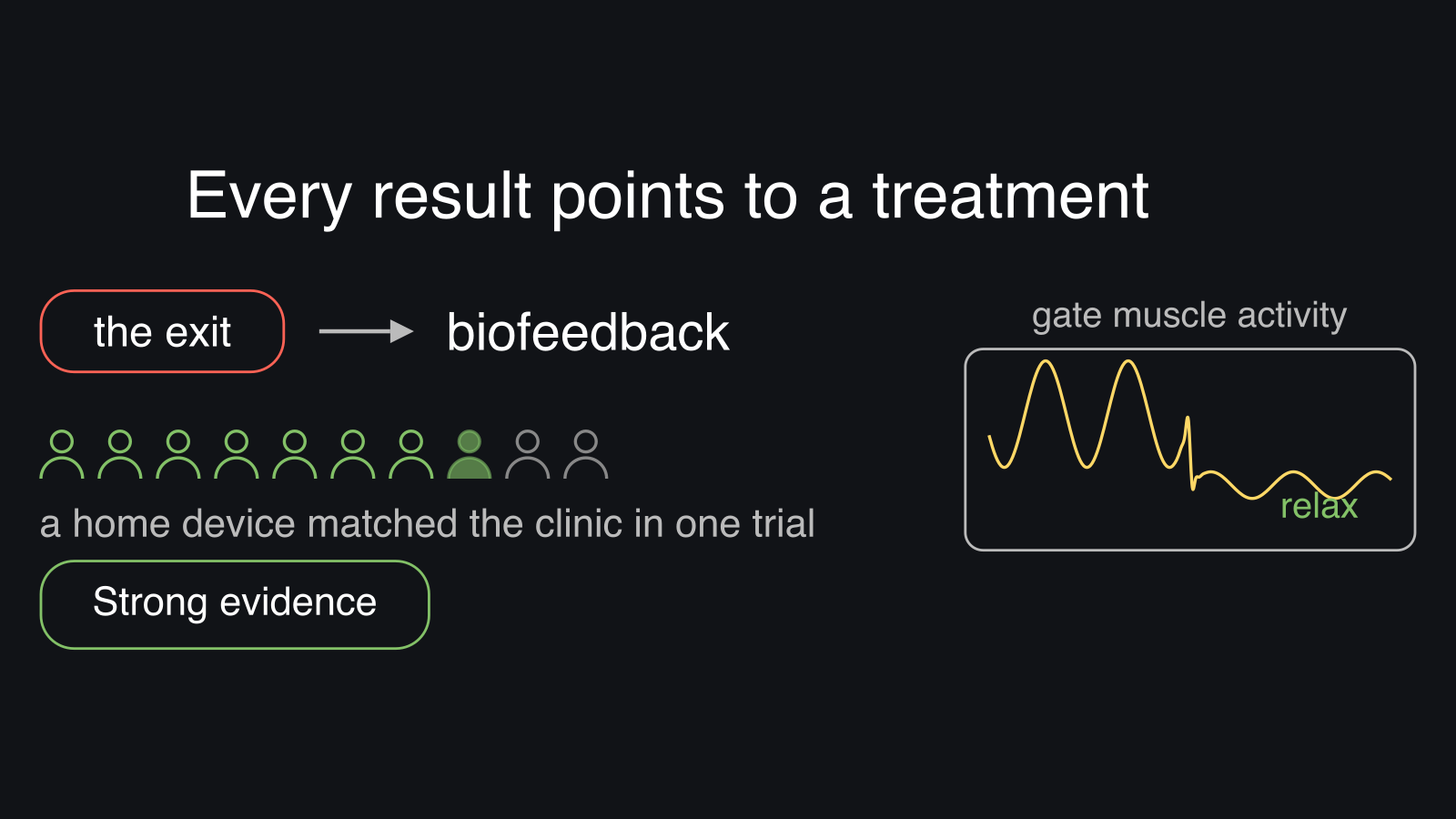
- The exit
An evacuation problem may point toward biofeedback.
- Feedback from a sensor
Practice with information about muscle activity.
- The research comparison
A home version matched the clinic version in one trial.
The source labels this strong evidence for assessed treatment. A standalone breathing or release exercise is not the same treatment package.
If it's the doorbell, there's sensory retraining with a specialist. They use a balloon to teach your rectum to notice smaller amounts. The studies are small, but it's the best option we have so far. And people with this root don't do as well with regular biofeedback, so knowing which one you have really matters.
Sources: Rectal hyposensitivity review.
If your colon is slow, your doctor has prescription medicines for that.
One more thing, from the psychology side. Biofeedback is really a learning treatment. You're retraining a habit your body picked up. And if stress or anxiety is a big part of this for you, it's okay to ask about psychological support too. Talking therapies like CBT and gut-directed hypnotherapy have good results in IBS, but they haven't really been tested for constipation itself. So think of them as an add-on, not the main fix.
What may help when the urge is missing?
How do you get the urge back? I break it into four steps: feed it, trigger it, answer it, and sharpen it. Each one comes from a different specialist, and most come with a guided routine. The companion resources at the end of this guide list the routines.
But first, let's match the steps to you. Remember your two questions and your quick check?
If senna works and it comes out easily, the doorbell steps may be relevant, but easy passage does not rule out an evacuation problem. These are possibilities to discuss, rather than a way to diagnose yourself. If nothing's arriving, lean on step one and step two: feed it and trigger it. If the bell is turned down, step four, sharpen it, plus the tests. If you've learned to ignore it, step three, answer it, is your main one. If the door won't open, the straining part near the end is for you, and that's where biofeedback comes in. And if medicines, stress or sleep came up, add the medicine review, the meditation and a steady bedtime.
Sources: AGA: refractory constipation patient guide.
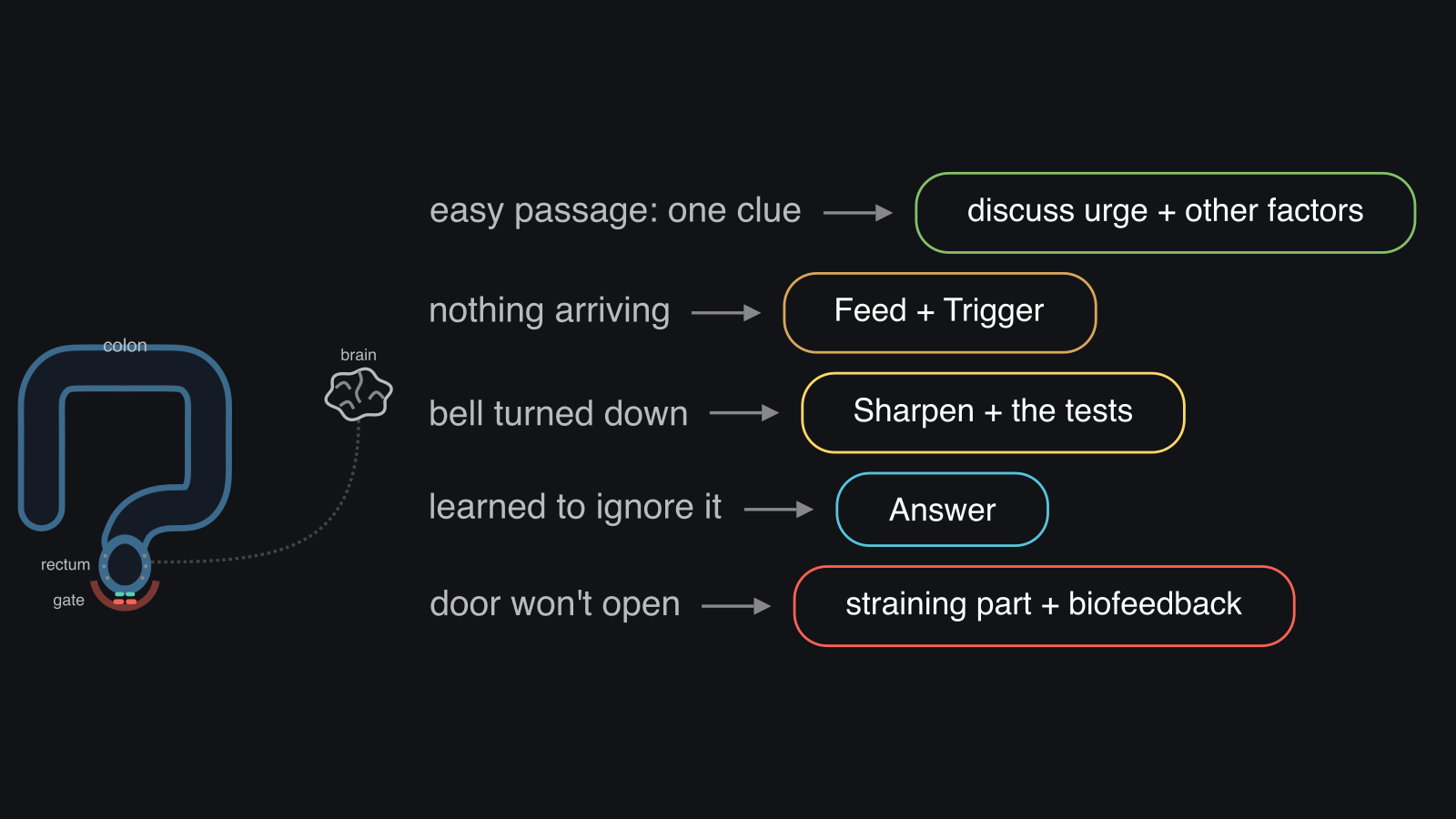
- Easy passage after senna
One clue: discuss the urge and other factors. It does not rule out an evacuation problem.
- Nothing arriving
Feed + trigger
- The bell is turned down
Sensory assessment + the tests
- Learned to ignore it
Toilet timing: answer the urge
- The door will not open
Discuss straining and biofeedback
This map organizes observations. Persistent straining, blockage or incomplete emptying deserves assessment.
Most people need a mix. So everyone does the morning routine, but put most of your effort where your yeses are. For our friend, my guess is feed, trigger and answer first, plus the straining part if he still strains on senna.
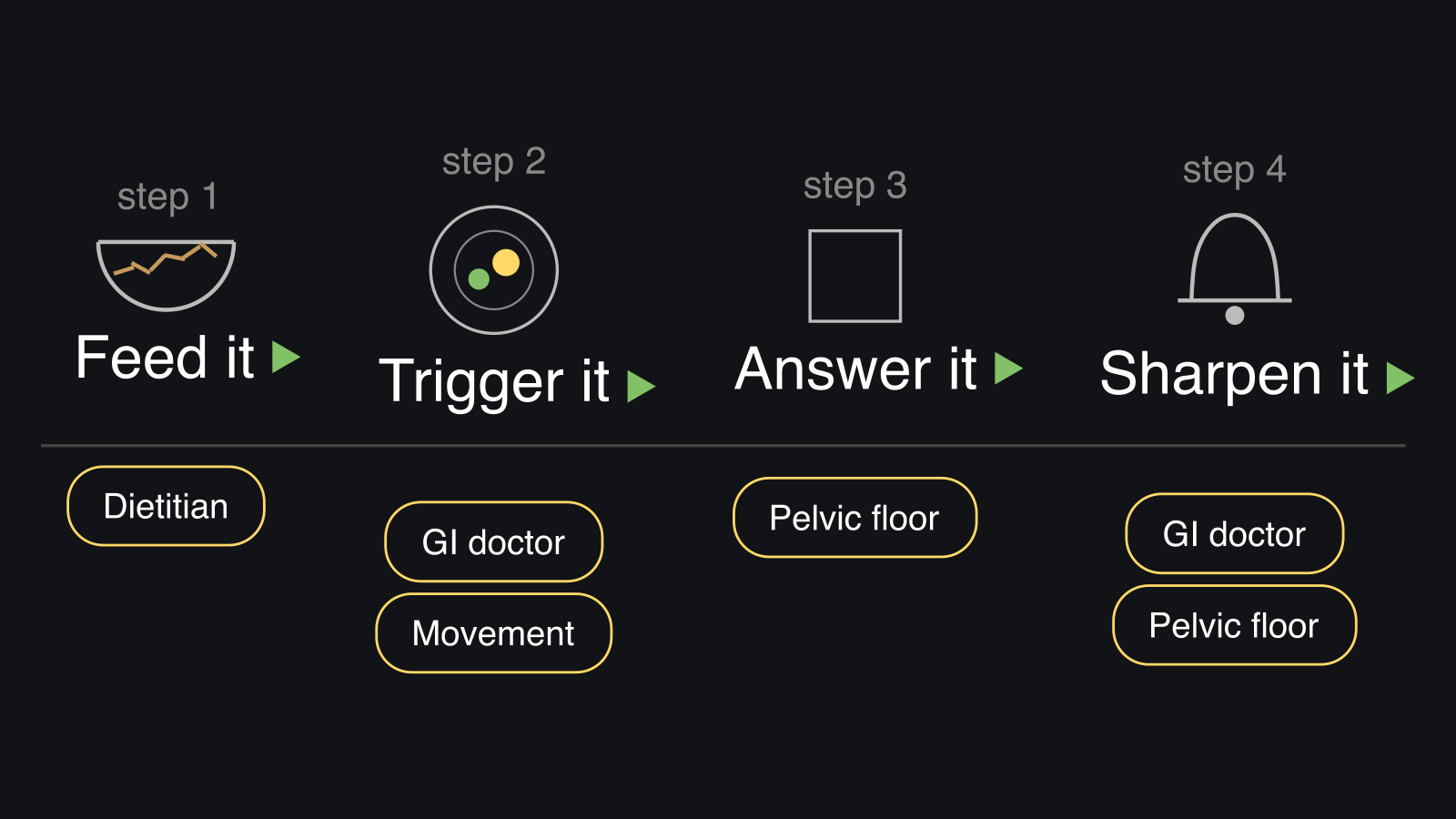
- 1 · Feed it
Food and stool consistency · dietitian
- 2 · Trigger it
Meals and movement · GI doctor and movement perspective
- 3 · Answer it
Toilet timing · pelvic-floor perspective
- 4 · Sharpen it
Urge awareness and assessment · gut–brain and pelvic-floor perspectives
Food, fiber and stool consistency (“feed it”)
Step one, feed it. This one's from the dietitian's perspective. If little is arriving, stool bulk and consistency are worth discussing. Psyllium husk is one fiber option supported by the research. A review included 16 trials and 1,251 participants overall. In the trials reporting treatment response, about two in three people improved on fiber, compared with four in ten in the control groups. Benefits were more apparent in studies using more than 10 grams a day and, for some outcomes, treatment lasting at least four weeks. Those subgroup findings do not establish a universal dose or minimum waiting time for every person. So don't judge it after a few days alone. The practical idea is to start small, build gradually—over two weeks in this example—and review tolerability and benefit over about a month with your clinician. Take psyllium with sufficient fluid, following the product instructions and any fluid restrictions. Bloating can mean the increase needs adjusting. The original research summary described this as moderate evidence; the guideline recommendation for fiber is conditional, with low-certainty evidence. Our psyllium routine walks through the practical steps.
Sources: Fiber systematic review and meta-analysis, 2022 · AGA–ACG guideline, 2023.
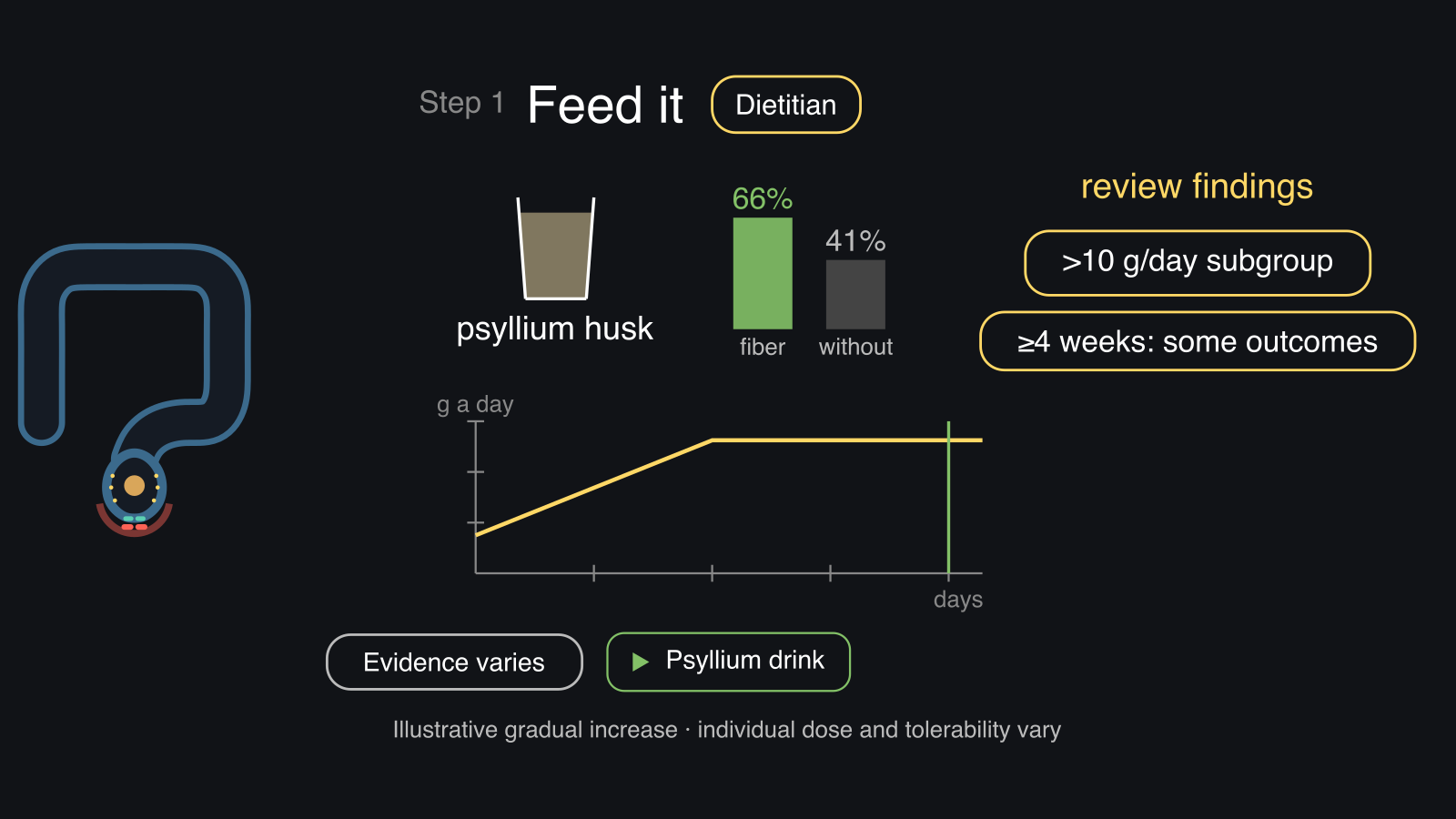
- Response-reporting subset
802 participants; the full review included 16 trials and 1,251 participants.
- Dose subgroup
Benefits were more apparent above 10 g/day.
- Duration subgroup
At least four weeks for some outcomes.
- Not an individual rule
Subgroup findings are not a universal dose or minimum waiting time.
Gradual increase → review and hold
The gradual-increase line is illustrative. Individual dose, fluid needs and tolerability vary. Evidence varies; the psyllium routine is a companion resource.
| Group | Responders | Total | Response |
|---|---|---|---|
| Fiber | 311 | 473 | 66% |
| Control | 134 | 329 | 41% |
The full review included 16 trials and 1,251 participants; not every trial reported this outcome. Definitions of response and interventions varied. Fiber systematic review and meta-analysis, 2022.
This is where your water finally earns its place. Water plus fiber works. Water alone, if you already drink enough, doesn't.
The British dietitians have a few more food ideas. Three kiwis a day. Rye bread. Mineral water that's rich in magnesium. Magnesium oxide, but check with your doctor first, especially if you have kidney problems. And certain probiotics, given at least four weeks. The studies are small, so limited evidence. But here's what I found interesting: plain "eat more fiber" advice didn't hold up well. Specific foods did.
Sources: BDA dietary guidelines for chronic constipation, 2025.
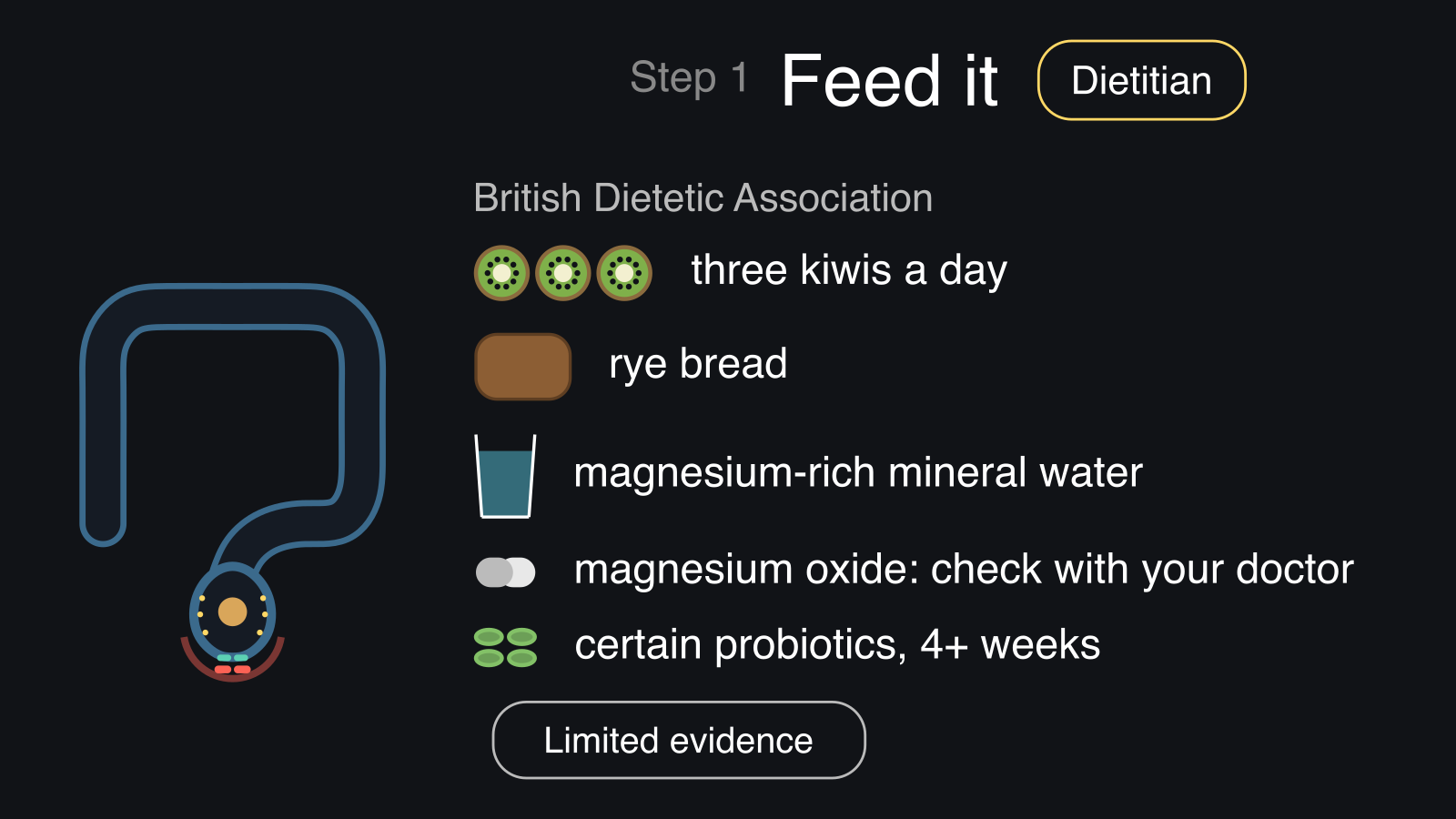
- British Dietetic Association
The source names these specific options.
- Kiwifruit
Three kiwis a day in the source example.
- Rye bread
A food option discussed.
- Magnesium-rich mineral water
A food and fluid option discussed.
- Magnesium oxide
Check with your doctor, especially with kidney problems.
- Certain probiotics
Four weeks or more in the source discussion.
The source describes limited evidence. These options and qualifiers remain explained in the article.
When you wake up, a glass of warm water. There's no research on it, but it's free, it's a nice cue to start your day, and there's a guided version.
Meals and movement (“trigger it”)
Step two, trigger it. This is from the gut doctor and the movement research. When you eat, your colon gets a signal to push. It's called the gastrocolic reflex, and it's usually strongest in the morning. So have a real breakfast. Not just coffee. Then go for a five to ten minute walk. Walking has the best evidence of any movement here, moderate, and our guided morning walk keeps you company. And if you love your belly massage, this is a nice time for it.
Sources: NIDDK: treatment for constipation.
Toilet timing and comfortable coordination (“answer it”)
Step three, answer it. This is the pelvic floor therapist's part, and if you change only one thing, make it this. Twenty to thirty minutes after breakfast, same time every day, sit on the toilet. Even if you don't feel anything. You're giving your body a regular appointment. That's the backbone of bowel training. On its own the evidence is limited, but it shows up in biofeedback programs too.
Before you sit, take two minutes of slow breathing to calm down. Then use the guided routines.
Put your feet on a footstool, knees above your hips, and lean forward. It helped healthy people strain less, but in one trial with constipated people, it didn't make a difference. The evidence is limited, but it's cheap, so try it.
Sources: Trieu and colleagues: footstool randomized trial, 2023.
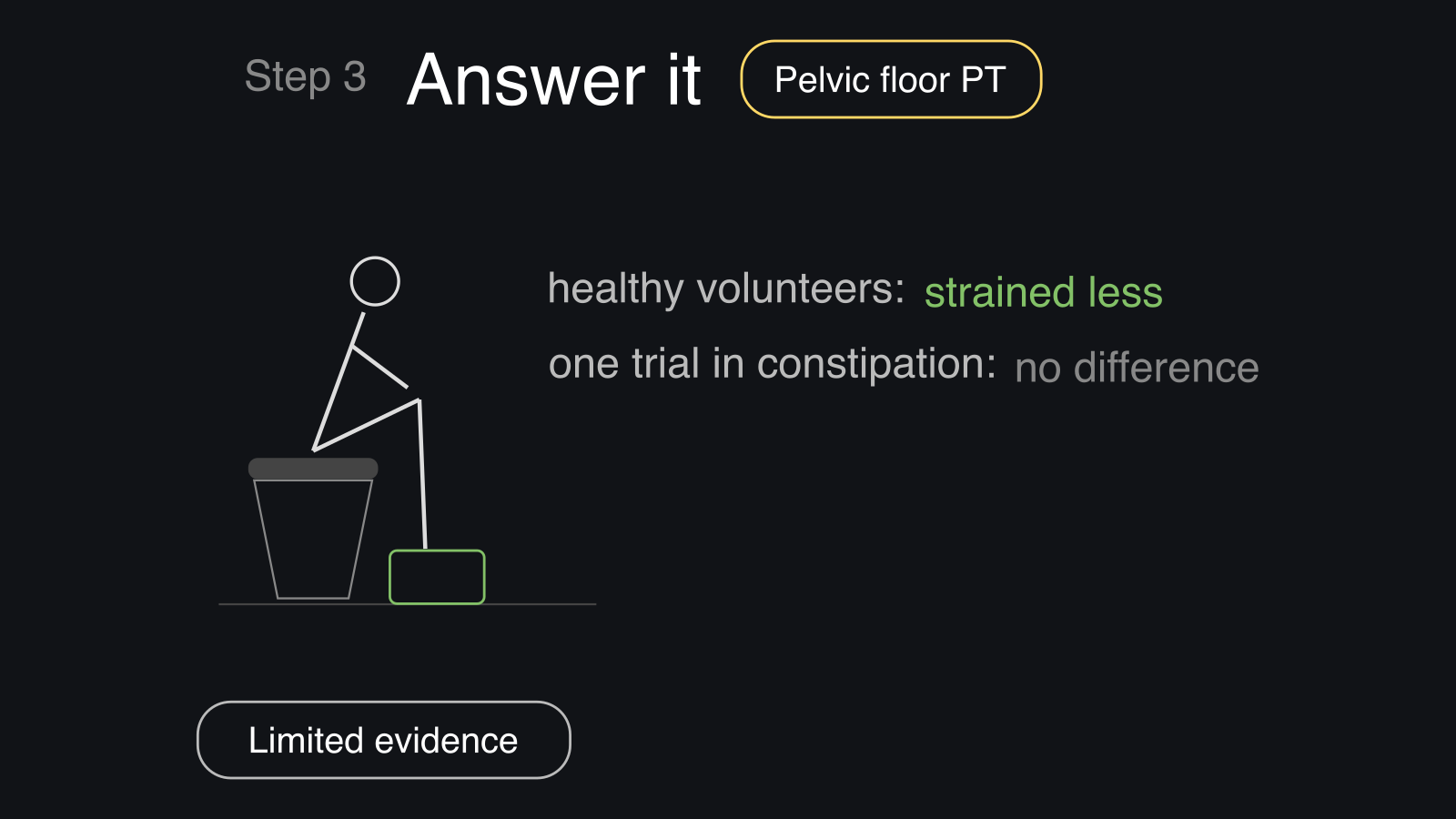

- Feet supported
- Knees raised
- Lean forward comfortably
- Healthy volunteers
Less straining in the source discussion.
- One constipation trial
No difference was found.
- Evidence
Limited and mixed.
Then belly breathing. Breathe in slowly, and let your pelvic floor drop and soften every time you breathe in. This one has decent evidence behind it, because it comes straight from biofeedback.
Then push and release. Your belly gently pushes out and down as you slowly breathe out, and your bottom stays soft. No straining. No holding your breath. Same source, same moderate evidence.
One tip from the trials: people practiced this breathing and pushing at home, 15 minutes, three times a day. Not just on the toilet. Our routines work anywhere, so use them.
Nothing after five to ten minutes? Get up. That's totally fine. Sitting longer just teaches you to strain. Try again tomorrow, same time. And during the day, if you feel the urge, go. Don't hold it. Every time you answer the doorbell, your body learns it's worth ringing again.
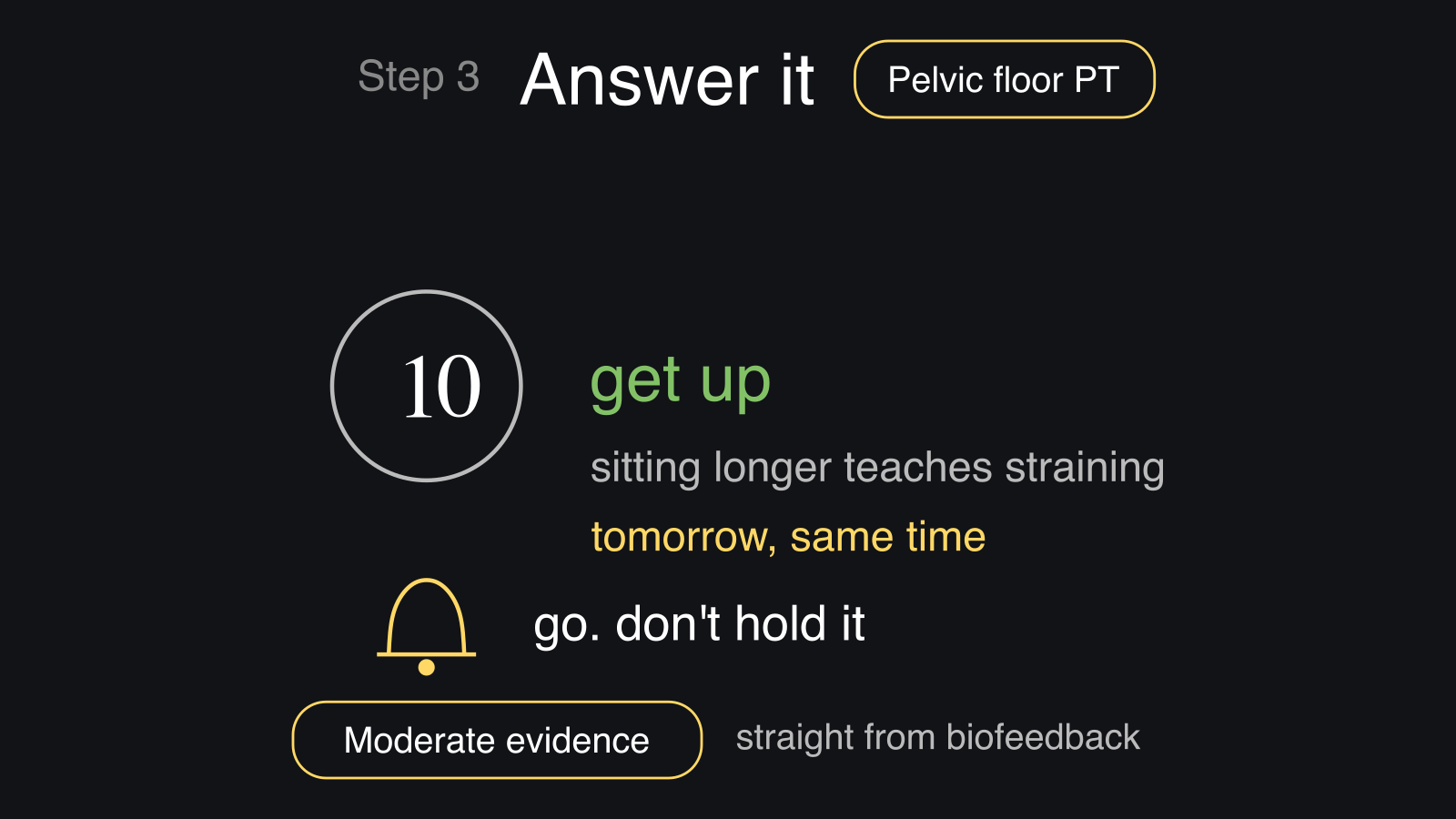
- Nothing after 5–10 minutes?
Get up rather than increasing effort.
- Tomorrow
Try again at the usual time.
- An urge during the day?
Respond rather than put it off.
The source links some components to biofeedback. That does not establish the same evidence for a standalone routine.
Urge awareness and sensory assessment (“sharpen it”)
Step four, sharpen it. While you're sitting, pay attention. Rate the urge from zero to ten, even if it's faint, and write it in your log. That's practice at noticing, not a cure. Real sensory retraining needs a clinic. So if weeks go by and you still feel nothing, that's your cue to ask about those tests.
Sources: Rectal hyposensitivity review.
If it comes, but won't come out: the pelvic floor therapist
Now, if the urge comes but it won't come out, here's one exercise to stop. Regular Kegels. They train your pelvic floor to squeeze. And if your floor is already too tight, pelvic floor therapists warn they can make things worse. Do reverse Kegels instead: a gentle letting go, like you're letting gas pass. Limited evidence, but it's what therapists use.
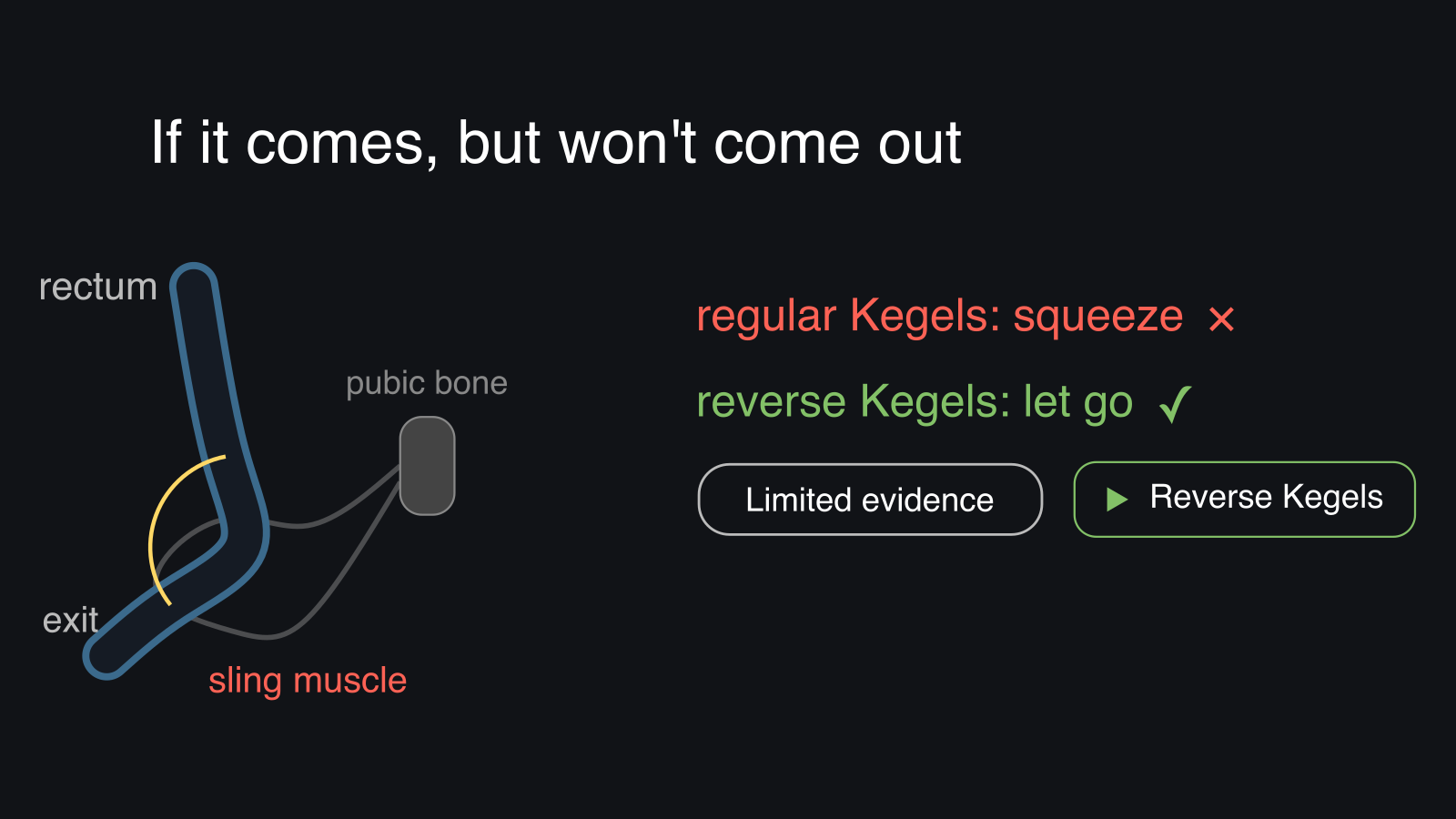
- Rectum
- Pubic bone
- Sling muscle
- Exit
- Regular Kegels
Squeeze.
- Reverse Kegels
Gentle letting go.
- Where it fits
The article discusses relaxation when the urge comes but passage is difficult.
Limited evidence for the standalone cue; follow individual advice. The drawing cannot diagnose muscle tension.
You can also try perineal acupressure: pressing gently on the spot between your genitals and your anus while you sit. In a trial of 100 adults at UCLA, people who learned it had better bowel function and felt better after four weeks. It's one small trial, so limited evidence. And if the straining doesn't go away, that's exactly what biofeedback is for.
Sources: Perineal acupressure randomized trial.

- Rectum
- Pubic bone
- Sling muscle
- Exit
- Location described
Gentle pressure between the genitals and anus.
- The study
100 adults · UCLA · four weeks
- Evidence
One small trial; limited evidence.
See the adjacent article text and safety notes. Persistent straining deserves assessment.
Evening and night: stress and sleep
In the evening, a second psyllium dose once you've built up, or a kiwi for dessert. If stress is part of your picture, try our audio meditation. There's no direct research in constipation, but it's low risk, and the breathing part comes from biofeedback.
Night: two minutes of slow breathing, and a steady bedtime, not too short and not too long. And senna stays where it is for now. We're not touching it yet.
How to discuss reducing senna with your clinician
Now, your real question. How do you stop depending on senna?
Start by agreeing any medication change with your clinician. I know it's tempting. The constipation senna was treating may return. You get backed up, take a big dose to catch up, and you're back where you started. The pharmacist's perspective is to understand and support the routine before reviewing a medication change. Here's the card.
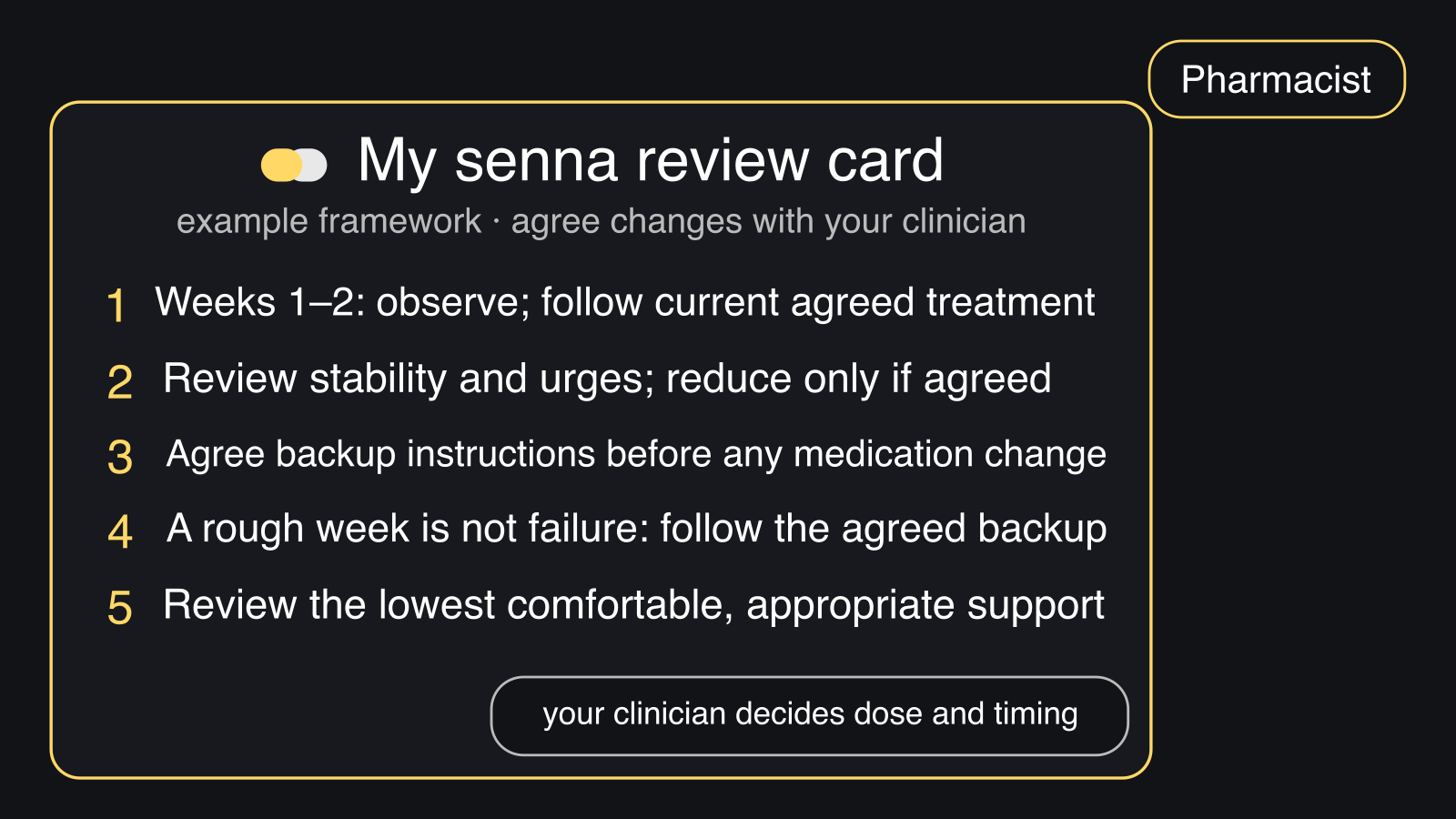
- Weeks 1–2 in this example: observe while following current agreed treatment.
- Review stability and urges. Reduce only if appropriate and agreed.
- Agree backup instructions before any medication change.
- A rough week is not failure: follow the agreed backup.
- Review the lowest comfortable, appropriate support—even when it is not zero.
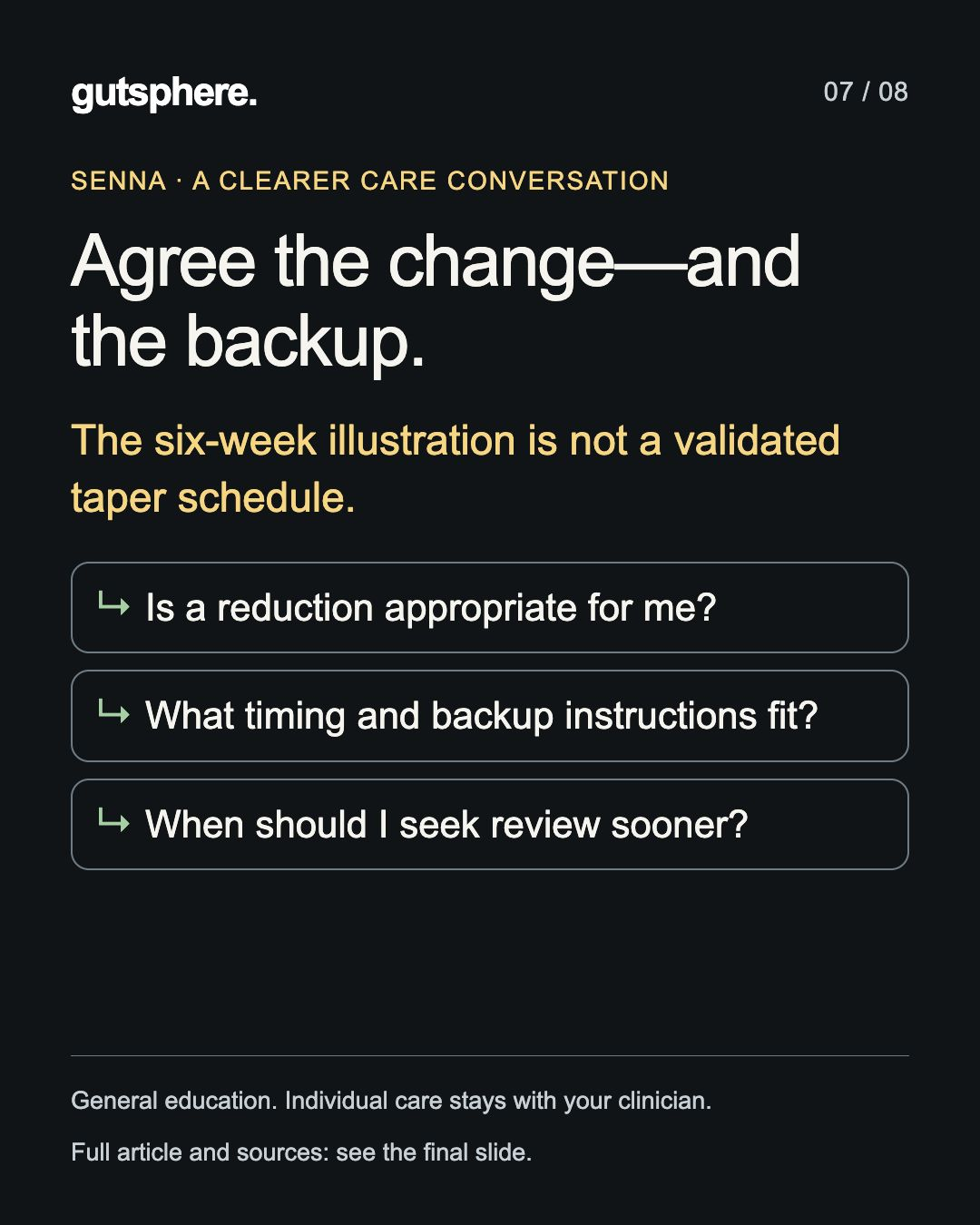
Your clinician decides dose and timing. This is an example framework, not a tested taper schedule.
One: begin with an observation period—two weeks in this example—while following your current agreed treatment. Two: review stability and any natural urges with your doctor; reduce only if a change is appropriate and agreed. Your doctor decides what a notch means for you and when to consider it. Three: agree on a rescue or backup rule before any change. When would you take senna again, seek advice or use another agreed option? Decide that in advance. Four: rough week? Follow that agreed backup plan and contact your clinician when instructed; going back to an agreed step is not failure. Five: review your lowest comfortable, appropriate support. It can be a win even if it isn't zero.
You mentioned laxatives, plural. If you take more than one, show your doctor the whole list, and step down one at a time.
And if you use a different kind of laxative, like PEG or lactulose, or a medicine or a condition is behind your constipation, like opioid painkillers, Parkinson's, a thyroid problem or pregnancy: the urge part of this guide still applies to you. But the step-down is a conversation with your doctor, not something to do on your own.
Your doctor might also suggest a gentler bridge while you step down. PEG is the only over-the-counter option US guidelines strongly recommend for long-term use. Psyllium and magnesium oxide are options too, with less evidence, and magnesium needs a doctor's okay if you have kidney problems. Doctors can also combine laxatives that work in different ways. So it's not senna or nothing.
Sources: AGA–ACG guideline, 2023.
I'll be honest with you. The supporting research did not establish a validated senna-taper schedule. This is an illustrative planning framework, not a tested protocol. The pace, any dose changes and backup instructions need an individual agreement with your doctor. I'm not giving doses.
Sources: NIDDK: treatment for constipation.
A few safety notes. Never go above the label dose without your doctor. Always take psyllium with a full glass of water. Don't hold your breath on the toilet. And skip the acupressure during a hemorrhoid flare.
An example six-week framework, with individual review
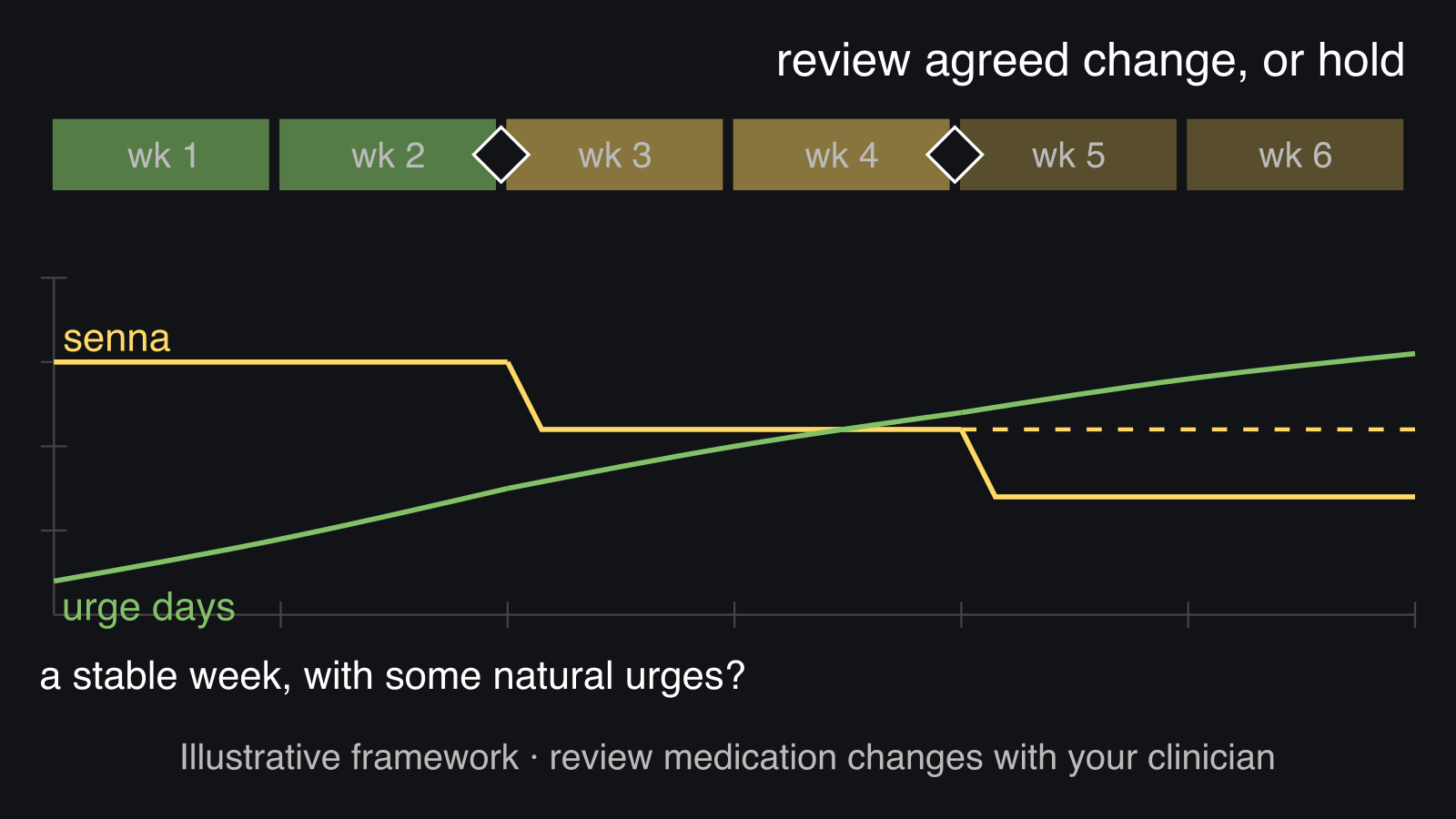
- Weeks 1–2 · observe
Follow current agreed treatment. Keep the routine and log.
- Weeks 3–4 · review
Discuss whether an agreed change is appropriate; natural urges alone do not dictate a reduction.
- Weeks 5–6 · review or hold
Review any further agreed change, or hold.
Compare laxative days and urge days with week zero. The original rising urge line and senna step line are illustrative, not patient data, forecasts or instructions. Medication changes require an individual plan.
Here's how it can come together as an example six-week framework. This is a way to organize observations and review, not a tested taper schedule. Medication changes, timing and backup instructions need an individual agreement with your clinician; you may need review sooner.
Weeks one and two: build the routine and keep your log while following your current agreed treatment. Keeping medication stable can make your observations easier to compare. Improvement during that period does not by itself prove that the routine caused it. Check-in one: did you sit in your window most days?
Weeks three and four: review whether a first change is appropriate with your clinician. Check-in two: a stable week, with some natural urges? That can inform the discussion; it does not automatically mean you should reduce senna.
Weeks five and six: review another agreed change, or hold. The week number does not determine whether or how much to reduce.
Every week, look at two numbers. Laxative days. Urge days. Put them next to your week zero, and notice how they change.
At the six-week review, you may recognize one of three patterns. Your urge days are going up? Discuss whether an agreed reduction is appropriate. You're better, but you still need some senna? Review the lowest comfortable, appropriate support with your clinician. Or nothing has changed at all? Then your log goes to your doctor, and you ask about those tests. None of these is failure. Each one gives you more information than you had six weeks ago.
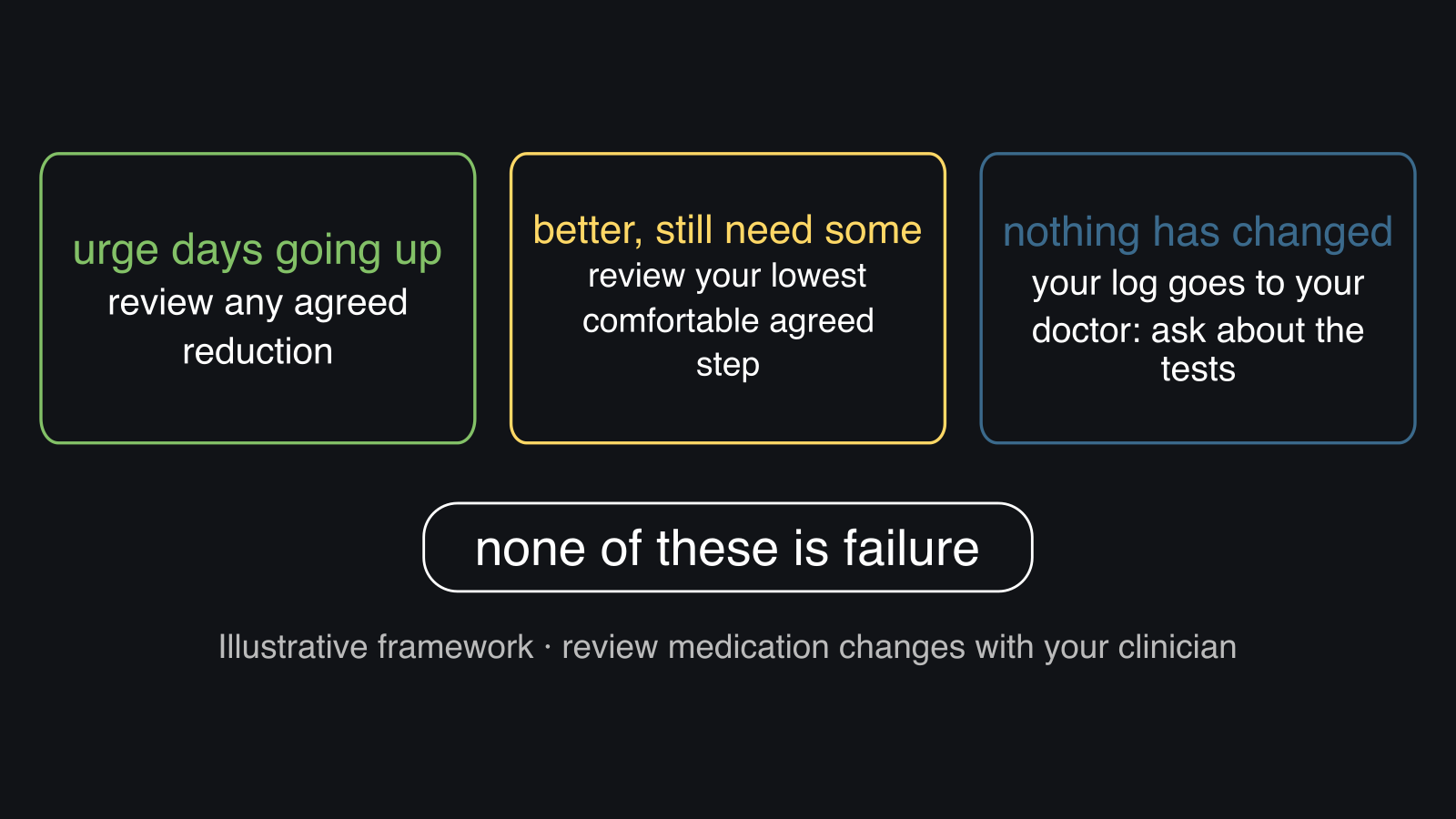
- Urge days going up
Review whether an agreed reduction is appropriate.
- Better, still need some
Review the lowest comfortable, appropriate support.
- Nothing has changed
Take your log to your doctor and ask about assessment.
None of these is failure. Review outcomes with your clinician.
What nobody knows yet
Before I wrap up, one honest thing. Some of this, nobody has tested yet. How to step down from senna. Whether a whole routine like this beats doing one thing at a time. And whether you can bring back a missing urge at home, without a sensor. So your log isn't just for you. It's real evidence about what works.
Your plan and next step
So, to my friend who wrote that comment, and maybe to you. The fear? Senna at normal doses probably isn't hurting your colon. The uncertainty? You can stay, or step down, with a plan and your doctor. And the doubt? Water and walking help. For you, they just weren't enough on their own, because a missing urge has roots they can't reach. So find yours from your pattern. Confirm it with your doctor. Then feed it, trigger it, answer it, sharpen it.
You can run this whole plan in the gutsphere app. It has the guided routines, and it tracks your laxative days, urge days and log, so you have your own evidence for your doctor. The app link will be added to the companion resources below.
Write down your answers to the two questions: do you feel the urge without senna, and when it works, does it come out easily? Add your week-zero numbers too, and return in six weeks with new ones. If someone in your family has been on laxatives for years, share this guide with them.
And tomorrow morning? Start small. Toilet window. Push and release. Both are included in the companion resources below.
Companion resources
Available tools and existing practices are linked below. Planned routines are clearly marked; the video link is still pending.
- Take this to your doctor: one-page sheet Quick-check tool and blank PDF
- Two-week log Online log and blank PDF
- One-page plan: your day and the senna card See the review card; worksheet pending
- Warm water on waking Planned routine · Coming soon
- Psyllium drink Planned routine · Coming soon
- Kiwi breakfast Planned routine · Coming soon
- Morning walk Planned routine · Coming soon
- Footstool and toilet posture Planned routine · Coming soon
- Breathing exercises Planned routine · Coming soon
- Push and release Planned routine · Coming soon
- Reverse Kegels Existing guided practice
- Perineal acupressure Planned routine · Coming soon
- Meditation Planned routine · Coming soon
- Gutsphere app Example app walkthrough
Sources and further reading
Original script · Supporting research and source list
- NIDDK: treatment for constipation
- AGA: refractory constipation patient guide
- AGA–ACG guideline, 2023
- AGA refractory constipation update, 2026
- Stimulant-laxative safety review, 2024
- NHS: senna uses and side effects
- MedlinePlus: senna
- Fiber systematic review and meta-analysis, 2022
- BDA dietary guidelines for chronic constipation, 2025
- NIDDK: constipation symptoms and causes
- Rectal hyposensitivity review
- Rao and colleagues: biofeedback trial, 2007
- Home versus office biofeedback trial, 2018
- Exercise systematic review, 2019
- Anti and colleagues: water plus fiber trial, 1998
- Kayıkçı and colleagues: abdominal massage review, 2020
- Trieu and colleagues: footstool randomized trial, 2023
- Perineal acupressure randomized trial
Research populations, certainty and interventions differ. In particular, clinic biofeedback is a treatment package; its trial results cannot be assumed to apply to a standalone breathing, posture or release exercise.