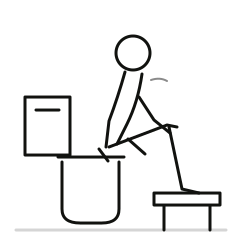
A short visual explanation of this experience and what to notice next.
One practical next step
Explore a guide or review.
Related practices appear first. Filter all fields to explore other guides and short reviews. Your pattern does not establish which one will work for you.
A more comfortable toilet position
At your pace · pelvic floor physiotherapy
Support your feet and lean forward gently, as described in NHS toilet-position advice.
02What can I do at home?Practical starting points, suitability, and limits.
General self-care education. Keep your own care instructions and restrictions in view.
Self-care educationMake your toilet position comfortableA supported position for an unhurried attempt.
Use a stable setup that suits your mobility. Persistent pain or difficulty deserves professional review.
Practical starting points
Sit fully and securely with feet supported.
If stable and comfortable, use a low footstool so knees sit a little above hips; lean forward.
Breathe out gently, perhaps with a quiet “moo” sound. Avoid holding your breath or straining.
Evidence
Patient guidance NHS patient guidance supports foot support, a forward lean, and a gentle exhale without breath holding. A brief app guide has not been tested for relief.
Timing
Comfort may change during an attempt; bowel relief is not guaranteed.
Self-care educationTake a comfortable breathing pauseA brief optional pause to settle, without breath holds.
Optional comfort practice. No forced deep breaths, breath holding, or bearing down.
Practical starting points
Sit in a supported position.
Let breathing stay gentle and comfortable.
Follow the visual only if it feels easy.
Return to your natural breathing whenever you want.
Evidence
Comfort support; constipation benefit unestablished Breathing can be used for relaxation. This short prototype practice has not been tested for constipation relief.
Timing
May feel settling now; no bowel-effect promise.
When to stop or get advice
Stop for dizziness, breathlessness, pain, or rising anxiety.
EducationLearn about kiwifruit and prunesFood approaches studied in adults with constipation.
Portion and suitability are individual; no study dose is converted into a personal regimen.
Questions and next steps
Read the evidence limits.
Consider allergy, tolerance, and existing dietary guidance.
Discuss a food-based trial if appropriate.
Evidence
Small comparative trial A four-week partially randomized trial found bowel improvements with kiwifruit, prunes, and psyllium; it had no untreated control.
Timing
Studied over four weeks; not an instant remedy.
When to stop or get advice
Stop a food causing an allergic reaction; seek appropriate help.
With a professionalGet help with a tolerable eating planBring food changes, restrictions, and symptoms to a dietitian.
Do not launch broad elimination diets from a symptom pattern.
Questions and next steps
Record changes already tried.
Note foods avoided and why.
Ask for a practical plan and review point.
Evidence
Government education; condition-specific Dietary support can individualize food changes. Low-FODMAP approaches are IBS-specific and should not become a blanket constipation diet.
Timing
Review over time with the professional.
When to stop or get advice
Discuss worsening symptoms or difficulty eating enough.
gastroenterologyOver-the-counter optionsCompare education about psyllium, PEG, and stimulant laxatives before a pharmacist or clinician discussion.
This list does not choose a product, dose, combination, or duration. Evidence and cautions differ; magnesium oxide is not every magnesium product.
EducationFiber supplements: psylliumUnderstand a bulk-forming fiber option.
Educational overview only; your clinician or pharmacist assesses suitability, interactions, and duration. Do not start, combine, stop, or change medicines from a pattern match. Check swallowing difficulties and required fluid instructions with a pharmacist.
Questions and next steps
Review the source and questions for a pharmacist or prescriber.
Follow your own product label and care instructions.
Record response and unwanted effects if already using it.
Evidence
Conditional recommendation; low certainty AGA/ACG conditionally suggests fiber; psyllium has the clearest support among evaluated supplements.
Timing
Varies; label and review plan govern.
When to stop or get advice
Use the product’s warning instructions; seek help for severe or unexpected symptoms.
EducationPolyethylene glycol (PEG)Understand an osmotic laxative.
Educational overview only; your clinician or pharmacist assesses suitability, interactions, and duration. Do not start, combine, stop, or change medicines from a pattern match.
Questions and next steps
Review the source and questions for a pharmacist or prescriber.
Follow your own product label and care instructions.
Record response and unwanted effects if already using it.
Evidence
Strong recommendation; moderate certainty PEG has guideline support for adult chronic idiopathic constipation. This does not establish the cause of a person’s symptoms.
Timing
Not an instant-relief promise; check the exact label.
When to stop or get advice
Use the product’s warning instructions; seek help for severe or unexpected symptoms.
EducationStimulant laxativesLearn about bisacodyl and senna.
Educational overview only; your clinician or pharmacist assesses suitability, interactions, and duration. Do not start, combine, stop, or change medicines from a pattern match.
Questions and next steps
Review the source and questions for a pharmacist or prescriber.
Follow your own product label and care instructions.
Record response and unwanted effects if already using it.
Evidence
Evidence differs by agent Bisacodyl has strong short-term/rescue support; senna has a conditional recommendation with lower certainty.
Timing
Depends on formulation; use its label.
When to stop or get advice
Use the product’s warning instructions; seek help for severe or unexpected symptoms.
EducationMagnesium oxideEvidence is specific to the magnesium formulation.
Educational overview only; your clinician or pharmacist assesses suitability, interactions, and duration. Do not start, combine, stop, or change medicines from a pattern match. Other magnesium products are not interchangeable evidence-wise.
Questions and next steps
Review the source and questions for a pharmacist or prescriber.
Follow your own product label and care instructions.
Record response and unwanted effects if already using it.
Evidence
Conditional recommendation; very low certainty AGA/ACG conditionally suggests magnesium oxide and cautions against use with renal insufficiency.
Timing
No exact benefit time established here.
When to stop or get advice
Use the product’s warning instructions; seek help for severe or unexpected symptoms.
gastroenterologyPrescription optionsLearn about medicines clinicians may consider for eligible constipation conditions and an inadequate response to other care.
A prescriber assesses diagnosis, safety, prior treatment, and interactions. A selected pattern cannot determine eligibility or change an existing prescription.
EducationLinaclotide and plecanatideMedicines a clinician may discuss for eligible conditions.
Educational overview only; your clinician or pharmacist assesses suitability, interactions, and duration. Do not start, combine, stop, or change medicines from a pattern match.
Questions and next steps
Review the source and questions for a pharmacist or prescriber.
Follow your own product label and care instructions.
Record response and unwanted effects if already using it.
Evidence
Strong recommendation; moderate certainty in CIC Both have guideline support for CIC after inadequate OTC response; prescribing depends on the clinical context.
Timing
Follow the prescribed review plan.
When to stop or get advice
Use the product’s warning instructions; seek help for severe or unexpected symptoms.
EducationLubiprostoneLearn about another prescription option.
Educational overview only; your clinician or pharmacist assesses suitability, interactions, and duration. Do not start, combine, stop, or change medicines from a pattern match.
Questions and next steps
Review the source and questions for a pharmacist or prescriber.
Follow your own product label and care instructions.
Record response and unwanted effects if already using it.
Evidence
Conditional recommendation; low certainty in CIC AGA/ACG conditionally supports lubiprostone in adult CIC after inadequate OTC response.
Timing
Follow the prescribed review plan.
When to stop or get advice
Use the product’s warning instructions; seek help for severe or unexpected symptoms.
EducationPrucaloprideA prescription option that acts on bowel movement.
Educational overview only; your clinician or pharmacist assesses suitability, interactions, and duration. Do not start, combine, stop, or change medicines from a pattern match.
Questions and next steps
Review the source and questions for a pharmacist or prescriber.
Follow your own product label and care instructions.
Record response and unwanted effects if already using it.
Evidence
Strong recommendation; moderate certainty in CIC Guideline support applies to adult CIC after inadequate OTC response.
Timing
Follow the prescribed review plan.
When to stop or get advice
Use the product’s warning instructions; seek help for severe or unexpected symptoms.
EducationLactuloseAn osmotic medicine to discuss with a prescriber.
Educational overview only; your clinician or pharmacist assesses suitability, interactions, and duration. Do not start, combine, stop, or change medicines from a pattern match.
Questions and next steps
Review the source and questions for a pharmacist or prescriber.
Follow your own product label and care instructions.
Record response and unwanted effects if already using it.
Evidence
Conditional recommendation; very low certainty Guideline support is conditional when other OTC approaches fail or are not tolerated.
Timing
Follow the prescribed review plan.
When to stop or get advice
Use the product’s warning instructions; seek help for severe or unexpected symptoms.
pelvic floor physiotherapyPelvic floor assessment and biofeedbackBiofeedback is a guideline-supported treatment for assessed problems with bowel-muscle coordination.
A toilet guide is not biofeedback. Do not select strengthening or relaxation drills from these pattern labels.
With a professionalAsk about bowel biofeedbackLearn how specialist-guided coordination training works.
Symptoms alone do not establish this diagnosis. Generic Kegels or reverse Kegels are not substitutes.
Questions and next steps
Describe difficulty passing and emptying.
Ask whether an assessment would be useful.
Follow the therapist’s specific instructions if recommended.
Evidence
Strong guideline recommendation for diagnosed dyssynergia ASCRS recommends biofeedback for symptomatic pelvic-floor dyssynergia after assessment.
Timing
A course of care; the professional sets the schedule.
When to stop or get advice
Report pain or worsening during assigned practice.
GI psychologyGI-focused psychological supportCBT and digestive-focused hypnotherapy may help IBS symptoms as part of professional care.
IBS evidence is not evidence for every form of constipation. A short breathing pause is a comfort option, not the same treatment.
With a professionalLearn about GI-focused psychological supportExplore CBT or gut-directed hypnotherapy with a professional.
IBS-specific evidence must remain labeled.
Questions and next steps
Ask whether this support fits your needs.
Check the practitioner’s training.
Continue appropriate medical care alongside it.
Evidence
IBS evidence; not universal constipation evidence These therapies may help IBS symptoms; evidence does not mean symptoms are imagined or establish benefit for all constipation.
Self-care educationTake a comfortable breathing pauseA brief optional pause to settle, without breath holds.
Optional comfort practice. No forced deep breaths, breath holding, or bearing down.
Practical starting points
Sit in a supported position.
Let breathing stay gentle and comfortable.
Follow the visual only if it feels easy.
Return to your natural breathing whenever you want.
Evidence
Comfort support; constipation benefit unestablished Breathing can be used for relaxation. This short prototype practice has not been tested for constipation relief.
Timing
May feel settling now; no bowel-effect promise.
When to stop or get advice
Stop for dizziness, breathlessness, pain, or rising anxiety.
multidisciplinaryOther approaches and their limitsReview abdominal massage, practitioner-delivered electroacupuncture, and uncertainty around probiotics.
Study populations and methods differ. These pages do not authorize a home technique, select a supplement, or establish benefit for your pattern.
EducationUnderstand abdominal massageReview evidence and suitability before trying a technique.
Pregnancy, recent abdominal surgery, inflammatory bowel disease, abdominal masses or obstruction, and spinal injury require exclusion or professional review. Hernia requires professional advice.
Questions and next steps
Review whether massage is appropriate.
Ask a qualified professional about technique.
Use only a reviewed guide matched to that advice.
Evidence
Small trial; applicability limited A trial in women found some benefits with massage added to lifestyle advice. It does not validate a one-minute app massage.
Timing
Studied as repeated care, not established as immediate relief.
With a professionalElectroacupuncture: evidence and limitsA practitioner-delivered approach studied in severe constipation.
Evidence for severe functional constipation must not be substituted for IBS evidence or a generic acupuncture claim.
Questions and next steps
Review the study population and burden.
Discuss suitability and practitioner credentials.
Evidence
Primary trial; setting and protocol limited One large sham-controlled trial in China found more complete spontaneous bowel movements over eight weeks. This does not validate home acupressure.
Timing
Studied over eight weeks; not immediate relief.
When to stop or get advice
Report adverse effects to the treating professional.
EducationProbiotics: understand the uncertaintyEffects cannot be assumed across products or strains.
Seek professional advice, especially with serious illness or reduced immunity.
Questions and next steps
Read the limits of the evidence.
Discuss the exact product and health context.
Evidence
Mixed and uncertain; IBS scope NCCIH finds insufficient certainty for routine IBS benefit; products differ. This is not proof of a microbiome deficiency.
04What might a clinician assess?Possible diagnoses and how they are evaluated.
A clinician starts with your history, medicines, and an examination. Blood or other tests are selected when there is a reason; no checklist fits everyone.
These are examples to understand, not a diagnosis or a ranking of what you have.
Functional or chronic idiopathic constipationA clinician may use these labels for ongoing constipation after considering secondary causes and the clinical picture.
How it is assessed
History and examination come first. Selected blood tests or other investigations depend on the findings.
What this does not tell you
Not identified by a pattern choice. There is no single test that confirms every case, and this portal does not apply diagnostic criteria.
Colonoscopy when indicatedA camera examines the lining of the rectum and colon; tissue samples may be taken.
What it can show
Visible changes such as inflammation or growths, with samples providing additional information when needed.
What it cannot establish
It does not measure pelvic floor coordination or colon transit, and a normal result does not explain every constipation pattern.
When it may be considered
Screening needs, bleeding, anemia, weight loss, family history, or other clinical concerns may make it appropriate. Constipation alone does not mean everyone needs it.
Not everyone needs every test. Your clinician chooses tests from your history, examination, warning signs, and response to care.
Get medical advice right away for constipation with bleeding, constant belly pain, vomiting, fever, or inability to pass gas.
Unexplained weight loss or new lower-back pain with constipation also needs prompt medical advice. If pain is severe, symptoms are rapidly worsening, or you feel seriously unwell, seek urgent care. Arrange a medical review for a sudden bowel-habit change or constipation that keeps returning despite self-care.